Adeia's $600 Million Flex: When a Patent Troll Grows Up
 kev_larFounder & Lead Developer
⚠️ Not financial advice. This post is for informational and educational purposes only. Forecasts and commentary are model outputs and opinions, may be inaccurate, and are not a recommendation to buy or sell any security or asset. Do your own research. AI-assisted: this article was drafted with AI and reviewed by a human before publishing.
 # Adeia's $600 Million Flex: When a Patent Troll Grows Up
Let's get one thing straight: Adeia makes its money by owning ideas and suing (or licensing to) people who use them. That business model has always made a certain kind of investor twitchy — it feels less like owning a company and more like owning a very well-lawyered toll booth. But three days ago, the toll booth operator stood up and said its long-term revenue target just jumped to $600 million, and suddenly everyone's paying attention again.
The Numbers That Actually Matter
Q2 2026 revenue landed at $96.1 million, basically in line with estimates, but EPS of $0.34 blew past the $0.29 consensus — a 13% surprise on the bottom line while the top line barely moved the needle. That's the tell: this isn't a story about Adeia suddenly selling more stuff. It's a story about a business that's getting dramatically more profitable at the same revenue level, with adjusted EBITDA margins parked at a plush 59%. When your cost structure is basically lawyers and licensing negotiators, that's what scaling looks like.
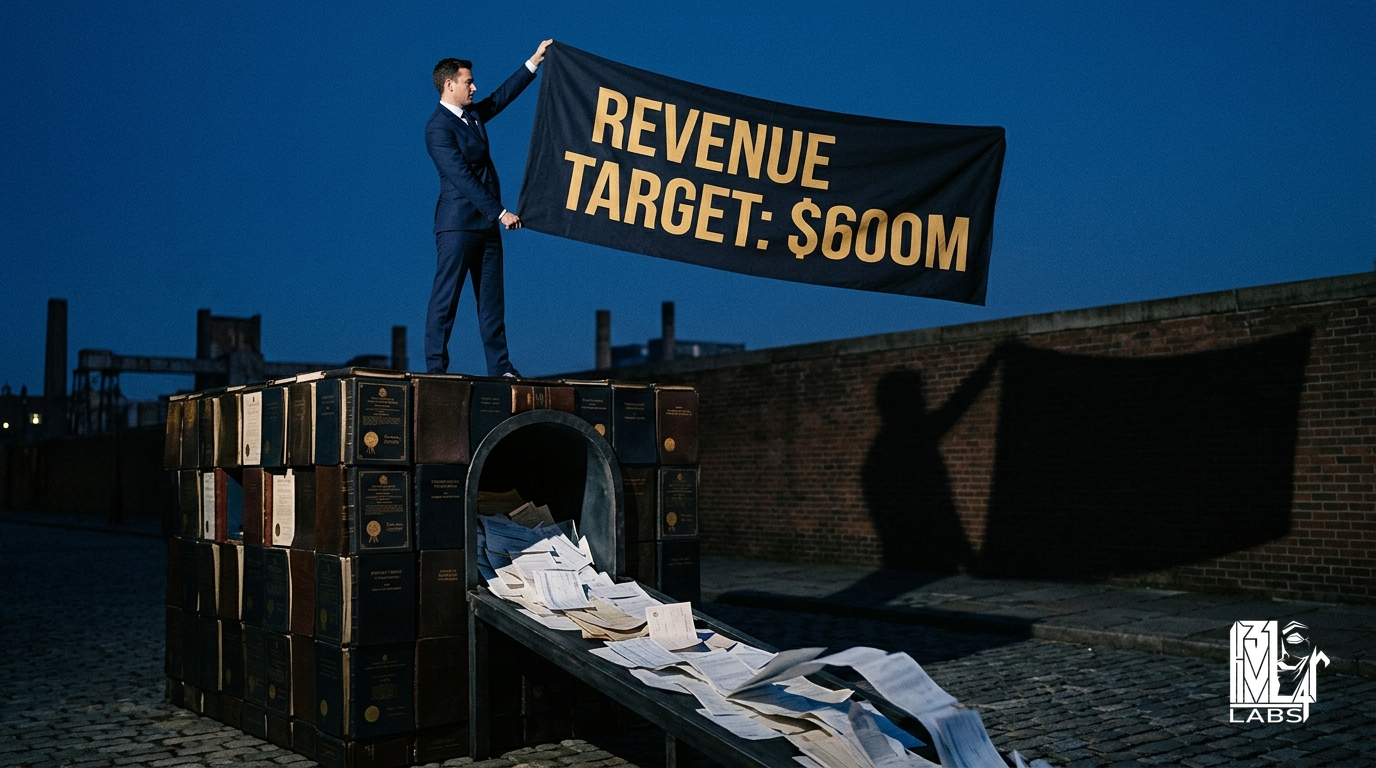
But the real headline wasn't the beat — it was the guide. Adeia raised its long-term annual revenue target to $600 million, explicitly pointing to hybrid bonding adoption in semiconductors as the engine. And the diversification data backs up the swagger: non-Pay-TV recurring revenue grew 54% year-over-year and is now nearly double the size of the legacy Pay-TV book. For a company that spent the last decade being written off as a cord-cutting casualty waiting to happen, that's a genuine identity shift — from "patent troll riding a dying industry" to "IP licensor with a foothold in the most important trend in chip packaging."
The Math Homework Nobody's Doing
Here's where I get a little squinty-eyed. Full-year 2026 guidance still stands at $395–$435 million in GAAP revenue. Q1 delivered $104.8 million, Q2 delivered $96.1 million — that's roughly $201 million through the first half. Do the subtraction and Adeia needs somewhere between $194 million and $234 million in the back half of the year to hit the guide. That's not a modest ask. IP licensing revenue is inherently lumpy — it lives and dies by when big deals actually close, not by smooth quarterly cadence — and management's own language about a pipeline with "multiple paths to guidance" is corporate-speak for "we don't have one sure thing locked, we have several maybes." Roth Capital clearly isn't worried, hiking its target to $43 after Q1. The broader analyst consensus, sitting around $33.60 with a Strong Buy rating, agrees. But at least one quant model out there (for what it's worth) pegs fair value closer to $25, with only 1 of 10 internal projections showing upside from current levels. When the sell-side and the spreadsheets disagree this much, that's not noise — that's a real debate about what this business is worth.
What I'd Actually Watch
Forget the headline growth number for a second and watch two things: whether the H2 licensing pipeline actually converts into signed deals (not "conversations," not "multiple paths" — signed contracts), and how the Dish Network patent suit shakes out. Litigation against a Pay-TV player is a two-way street — it either forces a lucrative settlement or it exposes cracks in the old licensing book that customers are increasingly willing to fight rather than renew.
The stock has run hard off its 52-week lows, and there's been some insider selling worth noting alongside a short float north of 7%, so this isn't a one-way freeway. But the underlying thesis — that Adeia is quietly turning semiconductor IP into a bigger business than its legacy Pay-TV cash cow ever was — is no longer a hope, it's showing up in the actual mix shift.
Bottom line: Adeia earned the benefit of the doubt this quarter. Whether it's earned a $600 million future depends entirely on whether "multiple paths to guidance" turns into one very concrete, very signed road. Watch the deal flow, not the slide deck.
More on ADEA
Market commentary from the K3vl4r desk — not personalized investment advice. More posts →