Bunge Global: Great Beans, Great Debt, and a Stock That Can't Decide What It Wants to Be
 kev_larFounder & Lead Developer
⚠️ Not financial advice. This post is for informational and educational purposes only. Forecasts and commentary are model outputs and opinions, may be inaccurate, and are not a recommendation to buy or sell any security or asset. Do your own research. AI-assisted: this article was drafted with AI and reviewed by a human before publishing.
 # Bunge Global: Great Beans, Great Debt, and a Stock That Can't Decide What It Wants to Be
Bunge just posted revenue growth of 88% year-over-year and a stock that's down roughly 21% from its 52-week high. If that sentence feels contradictory, welcome to the agribusiness trade in 2026 — where the fundamentals and the chart are having two completely different conversations.
The Numbers Are Actually Good
Let's not bury the lede: Bunge beat. Q2 2026 adjusted EPS came in at $2.00 against a $1.95 estimate, GAAP diluted EPS hit $3.47, and revenue exploded to $24.04 billion. Management didn't just meet the moment — they raised full-year adjusted EPS guidance to $9.25–$9.75, up from the prior $9.00–$9.50 range. That's a company telling you business is getting better, not worse.
The engine here is the Viterra integration, completed July 2, 2025, which stitched together a genuinely more diversified global network. This quarter's strength came from exactly where the bulls said it would: North American processing margins holding up (even as refining lagged), and South America — Argentina processing/refining and Brazil processing — pulling real weight. Soybean and softseed crush is doing the heavy lifting, and for a company whose entire existence depends on squeezing margin out of commodity flows, that's the ballgame.
Q1 was no fluke either — 87.76% revenue growth and $1.81 adjusted EPS set the table. This is a two-quarter trend, not a one-off beat.
So Why Is the Stock Acting Like It Got Bad News?
Here's where it gets interesting. The chart shows price sitting at $106.46, well off the $134.87 52-week high, with both the 20-day and 50-day moving averages rolling over hard (-9% and -12.6%, respectively). RSI at 31 says oversold. Translation: somebody sold this rally aggressively, and it wasn't retail chasing headlines — Seeking Alpha's own downgrade flagged the risk/reward shifting after the explosive run, which is analyst-speak for "great story, priced in, now what."
That "now what" question matters because underneath the crush-margin good news, Bunge's balance sheet isn't pretty. Debt-to-equity sits at 93.21% — high by any standard, and especially high for a business that just swallowed a company the size of Viterra. Free cash flow went negative $877 million in Q1 2026, a sharp reversal from the positive $809 million generated the prior quarter. Gross margins of 5.22% and operating margins of 2.41% are normal for a trading house living off volume, not vig — but they leave almost no room for error if crush spreads compress or integration costs run hot.
My Take
This is a classic "great business, tricky stock" setup. The bull case — diversified global footprint, raised guidance, Zacks Rank #1 Strong Buy status, a 2.71% dividend that's actually being covered by real earnings — is legitimate and not hype. Bunge earned its guidance raise this quarter.
But the market already ran this stock up near $135 pricing in a clean integration story, and now it's digesting the reality that clean integrations of this size don't happen without cash flow lumps and leverage headaches along the way. The negative free cash flow print isn't disqualifying, but it's a flashing yellow light for anyone assuming this is a straight line to $145.
The setup I'd actually watch: $90.20 is the line in the sand — the forecast band's lower support and roughly where the "this thesis broke" threshold sits. Above that, this is a name to accumulate on weakness given the earnings trajectory. Below it, the debt story stops being a footnote and becomes the headline.
Bottom Line
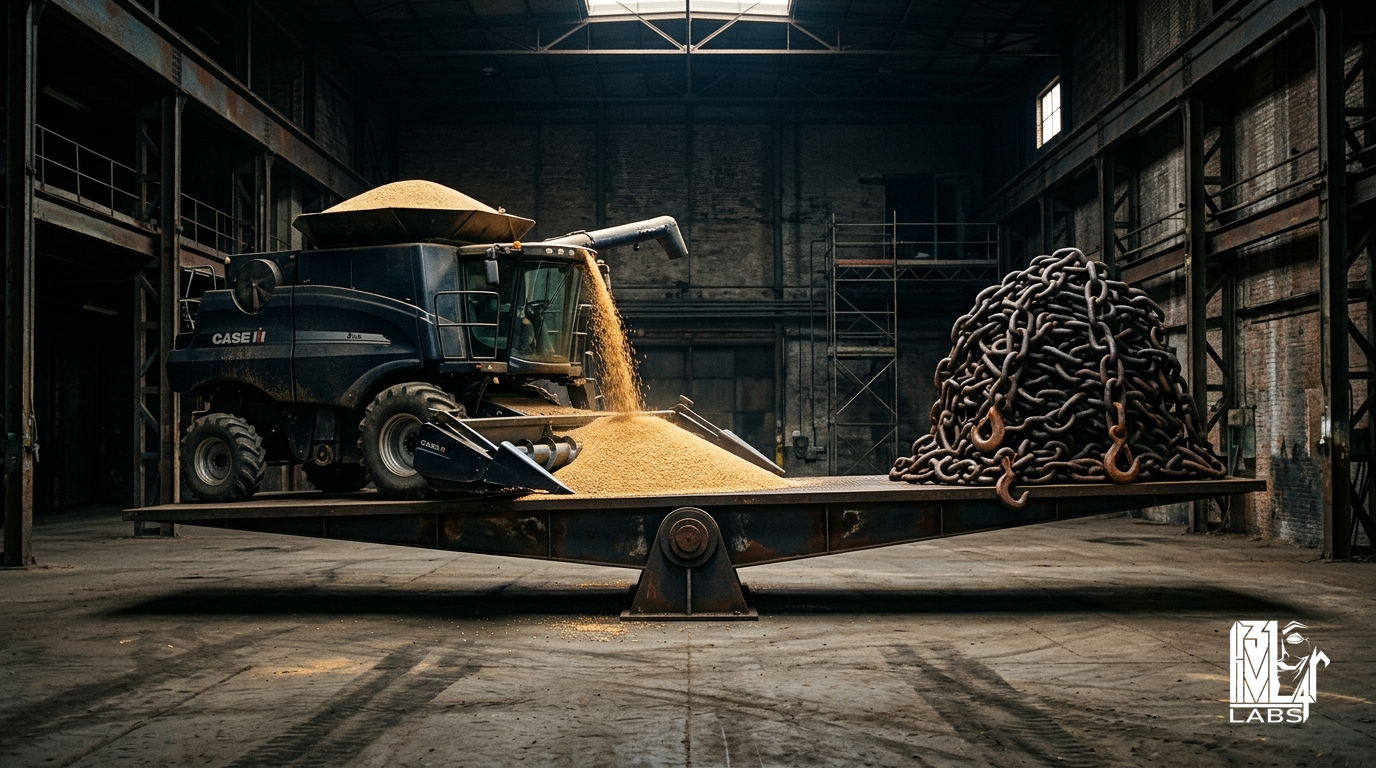
Bunge is doing exactly what a post-merger agribusiness giant is supposed to do — grind out margin, diversify geography, raise guidance. The stock's pullback isn't a referendum on the business; it's the market re-pricing risk after chasing the story too hard, too fast. Watch $90 as your floor, watch the next earnings print to see if free cash flow stabilizes, and don't confuse a healthy digestion phase with a broken thesis. The beans are fine. It's the balance sheet that needs to prove it can carry the weight.
More on BG
Market commentary from the K3vl4r desk — not personalized investment advice. More posts →