EIX Just Got Eviscerated Over a Bill That Didn't Even Pass
 kev_larFounder & Lead Developer
⚠️ Not financial advice. This post is for informational and educational purposes only. Forecasts and commentary are model outputs and opinions, may be inaccurate, and are not a recommendation to buy or sell any security or asset. Do your own research. AI-assisted: this article was drafted with AI and reviewed by a human before publishing.
 # EIX Just Got Eviscerated Over a Bill That Didn't Even Pass
Let me set the scene, because the story here is uglier than the headline suggests.
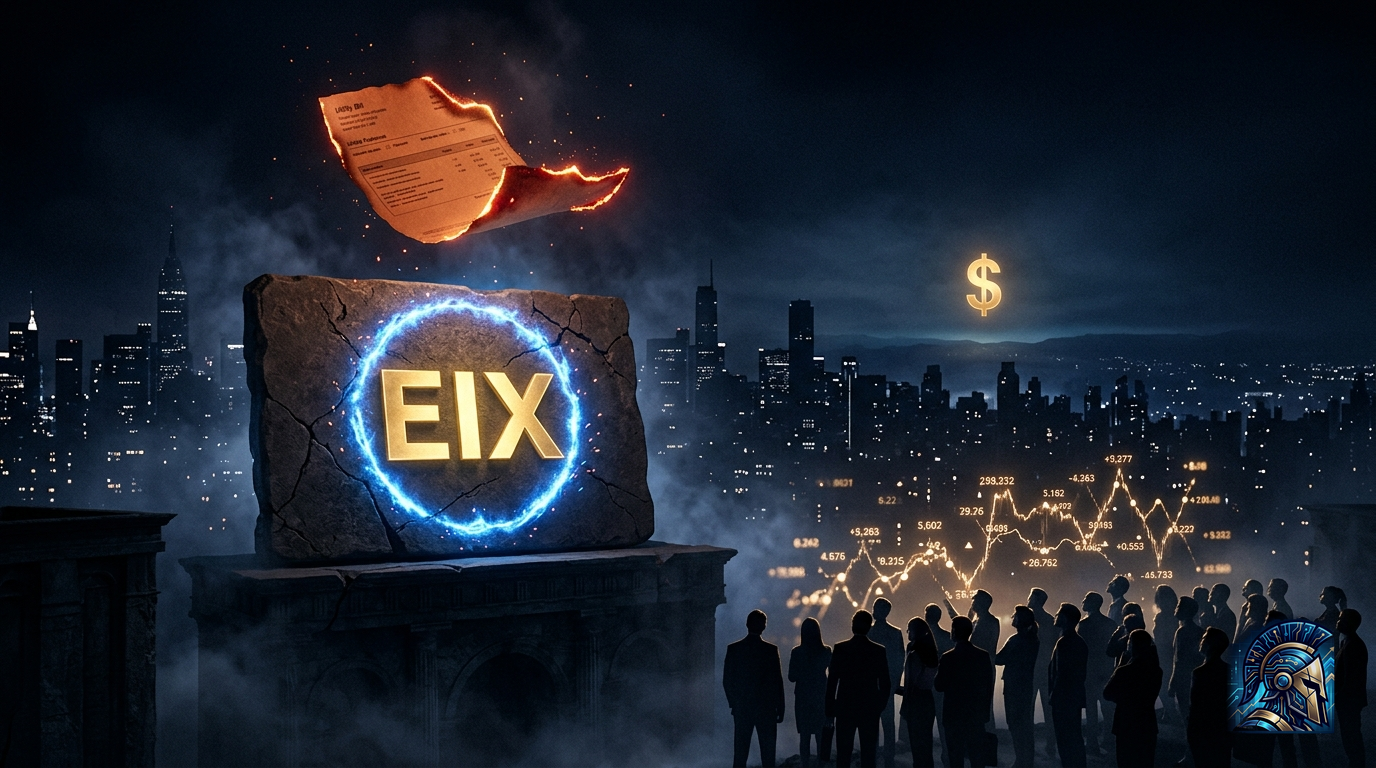
California's legislature walked out on August 31, 2026, without voting on the California Wildfire Liability Bill. That alone would have been a nuisance. But over the weekend, lawmakers pushed an amended version that stripped out exactly what the utilities had been counting on: the liability-cap protections. The market didn't so much react as convulse. Edison International (EIX) plunged roughly 24% on September 2 — I've seen the figure cited as a 24.2% single-day wipeout, landing near $53. Peer PG&E shed about 18%. This wasn't an EIX problem. It was a sector-wide repricing of an exposure everyone had quietly agreed to ignore.
Here's the thing that keeps me up at night about this drop: the stock crashed over legislation that never actually became law. The liability caps are gone from the table, but so is the bill itself. The regime right now is "everything is back on the table and nobody knows the ending." That is a terrifying place to own a regulated utility, because the market would rather price in catastrophe than wait for clarity.
Now let's talk about what's actually real underneath the panic, because the tape and the balance sheet disagree with each other.
The business is not on fire. EIX beat Q2 2026 adjusted EPS estimates and reaffirmed its full-year core EPS guide of $5.90–$6.20. It also laid out 2027 ($6.25–$6.65) and 2028 ($6.74–$7.14), with management still preaching a 5–7% core EPS CAGR through 2030. CEO Christian Pizarro had warned, before all this, that delays on wildfire reform could trigger credit downgrades — and he was right to. Analysts are now treating that downgrade risk as gospel.
But note the contradiction: Morgan Stanley cut its target to $60 (from $65) and kept a Sell. Jefferies dropped to $53 (Hold). JPMorgan slashed from $82 to $61 (Neutral). Truist trimmed to $63 (Hold). Mizuho to $70 (from $86). Weiss flipped from "buy" to "hold." The consensus target sitting at roughly $73–$74 in late August has been gutted across the board. This is a wall of desks exiting, not a single bearish thesis.
And there is a real bear case. Don't let me be the guy who calls a washout when the fundamentals are quietly deteriorating. Revenue fell ~4% year-over-year in Q2. Operating margins compressed to about 30% on higher debt costs. Debt-to-equity sits near 2.5. SCE has already handed out offers to 5,400+ Eaton Fire claimants and is sitting on well over $500 million — some estimates put it north of $675 million — in wildfire compensation, with the claims window open until November 30. Some analysts are forecasting earnings collapsing toward $2.5 billion by 2029. That's not paranoid; that's a line item someone is actively modeling.
So where does that leave the bulls, and are they wrong?
They've got three things going for them that the tape is ignoring. First, SCE says it's completed 93% of its physical grid hardening in high fire-risk areas — real, physical risk reduction, not a press release. Second, the $38–41 billion SCE capital program over 2026–2030 (roughly 7% annual rate base growth) is the engine of the whole regulated-utility thesis, and management is adamant it funds that without issuing new common equity — no dilution. Third, the dividend: a ~6.2% annualized yield off the $0.8775 quarterly payout. Management reads that as a signal of confidence, not desperation. I'll allow that reading, but only if the liability ceiling lifts.
There's also the electrification angle — the "sweet spot for data-center power demand" framing that every utility is currently leaning on — which is fair but not unique to EIX.
My take: This is a coin flip dressed up as a catastrophe, and the crowd is leaning hard on the tails side. A 24% single-day drop on a bill that didn't pass is a market mispricing most of the downside in. If the liability framework gets resolved favorably — or even if it just gets delayed again without killing the caps — the multiple re-expands fast, because the earnings guide never moved. The stock is trading near its $52 52-week low with a 6%+ yield and management refusing to dilute. That's a lot of pessimism folded into one price.
But I won't pretend the other side is weak. If credit agencies actually downgrade SCE during a capital-intensive period, borrowing costs spike precisely when they can least afford it, and the EPS CAGR thesis cracks. That's the scenario that turns "cheap" into "cheap for a reason."
What I'd actually do: don't catch this knife on the headline. The technicals are ugly — below the 200-day, bearish moving-average crossover, negative momentum. Let it find a floor. Watch $62.50 as support and the November 30 Eaton Fire claims deadline as the real catalyst. If reform gets resolved by then, you get the rebound cheaply. If it doesn't, you've avoided a value trap. The market has already priced the bad ending. I'd rather buy the ending I'm not sure about than pay up for the one everyone's running from.
Utilities don't die from headlines. They die from uncapped liabilities. Right now, EIX is being punished for a liability that is uncapped only in the market's imagination.
More on EIX
Market commentary from the K3vl4r desk — not personalized investment advice. More posts →