POPCAT Broke the Trendline. The Trendline Didn't Ask for Permission, and Neither Should You Believe the Rally.
 kev_larFounder & Lead Developer
⚠️ Not financial advice. This post is for informational and educational purposes only. Forecasts and commentary are model outputs and opinions, may be inaccurate, and are not a recommendation to buy or sell any security or asset. Do your own research. AI-assisted: this article was drafted with AI and reviewed by a human before publishing.
 # POPCAT Broke the Trendline. The Trendline Didn't Ask for Permission, and Neither Should You Believe the Rally.
Let's get the boring part out of the way so we can get to the fun part. POPCAT is a meme coin on Solana. It's backed by a cat. Not a metaphorical cat — an actual cat named Oatmeal who became a viral GIF in 2020, and somewhere along the line someone decided the cat needed its own token. Fixed supply of roughly 980 million tokens, mint authority revoked, everything circulating. No emissions, no vesting, no unlock overhang. There is also no company. No earnings. No revenue. No balance sheet. If you want fundamentals, you will have to sit down.
Right now POPCAT trades around $0.057, a market cap near $56 million, and it's up roughly 38% off its mid-June low of about $0.042. That's a real move. And it's exactly the kind of move that separates the people who get rich from the people who fund the people who get rich.
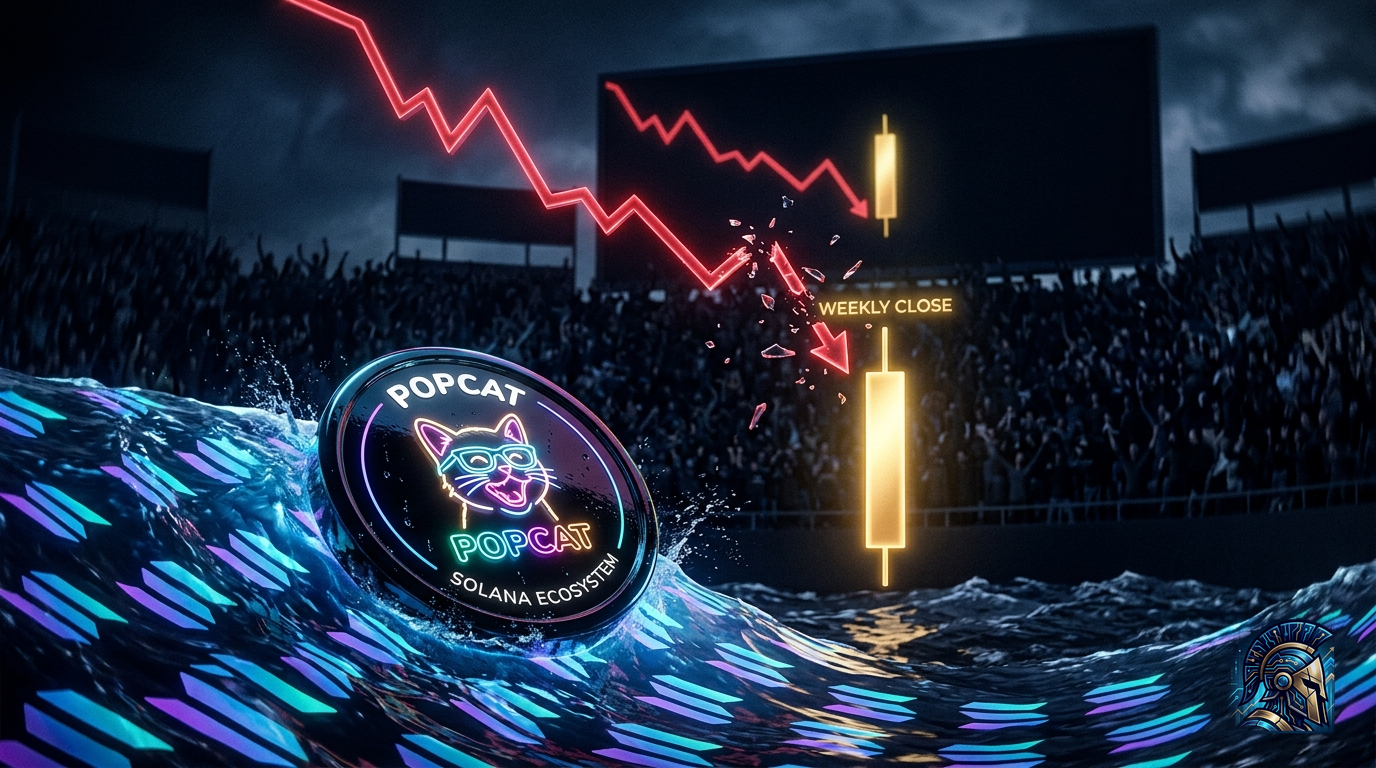
Here's what actually happened. On August 27th, POPCAT broke out of a descending trendline that had pinned its price to the floor for over a year. That's a legitimate technical event — trendlines that last that long don't break by accident, and when they do you get a bullish weekly candle and a crowd that suddenly remembers how to trade. Add a fresh Solana airdrop on August 23rd to stir the pot, plus a broad meme-and-altcoin rotation where capital dumped itself into anything with a pulse and a chart, and you have a recipe for a spike.
I'm going to be blunt about the recipe, because the recipe is the story.
The rally is real. It is also not POPCAT-specific. The Altcoin Season Index reportedly jumped roughly 50% in a week, a Bitcoin short squeeze flushed about $648 million in bearish bets, and everyone reached for the riskiest thing on the shelf at once. POPCAT rode that wave because it was already sitting near the bottom having lost roughly 97% of its value from the November 2024 all-time high of about $2.05. When an asset is down 97%, a 38% bounce doesn't require any new reason — it just requires the market to feel generous for five minutes.
Now the part where I ask you to do some arithmetic. The internal forecast model — the one that's supposed to tell us where price is going — has basically given up. Its directional accuracy over the last day sits at 30%, versus a naive baseline of 73% that you could beat by flipping a coin and calling it a trend. The forecast band is nearly flat: it thinks POPCAT should sit at $0.0528 and it's trading at $0.0575. That's not a prediction of upside. That's a model telling you the current price is a hair above where it expects to mean-revert, and it wants to drag you back down to its own number. When the expensive, complicated analysis loses badly to a coin flip, you don't lean on the expensive analysis. You respect the coin flip.
So what's the actual setup? There's a line in the sand, and it's not a vague one. POPCAT needs to hold the $0.050 level — the breakout retest. A clean hold and retest of that level is the only thing that confirms the breakout was for real. Lose it on a daily close and the whole thesis unwinds, and it unwinds fast, toward $0.042 and then the sticky $0.040 floor that's held this thing down for months. On the other side, the upside isn't a mystery either: $0.077 is the breakout confirmation level, and $0.115 is the next story.
I want to flag one thing that made me raise an eyebrow, because it's the kind of detail that gets glossed over. The Robinhood insider-trading charges reported September 16th sound dramatic, but they're not new news for POPCAT — they relate to a listing that happened in March 2025. The charges are the fresh part, and they're neutral-to-slightly-bearish on perception, mostly because they remind everyone that listings in this space come with a management of regulators watching closely. Don't mistake the court filing for a catalyst.
And then there's the crowd. Sentiment on the CFGI Fear & Greed index is averaging a cool, calculated 48 out of 100 — neutral, which in meme-coin-speak means nobody has committed yet. But StockTwits is reading 100% bullish. I have seen that exact reading, at exactly 100%, be the moment right before the other direction. When everyone who will ever be bullish is already bullish, there's a mathematical problem with the trade: who's left to buy?
Here's my actual view, and I'll defend it: POPCAT is a holding trade, not a faith trade. The breakout earned you a position. The model says the easy money may already be off the table and mean reversion is the more likely script. So hold the recovery, do not chase above $0.060, and keep your eyes glued to $0.050. Hold that level and you've got a legitimate technical thesis with $0.077 in sight. Blow through it on a daily close and the trendline break was a beautiful, expensive trap, and the cat goes back to sleeping.
This is a coin that has already told you exactly what it is — down 97% from its high, carried entirely by sentiment and rotation. It didn't hide that from you. In this market, the people who get hurt are the ones who fall in love with the story right after the story has already been told. POPCAT's breakout is a real thing. It's not a reason to fall in love with it.
More on POPCAT-USD
Market commentary from the K3vl4r desk — not personalized investment advice. More posts →