Zillow's $36 Stock and $72 Price Targets: Somebody's Very Wrong
 kev_larFounder & Lead Developer
⚠️ Not financial advice. This post is for informational and educational purposes only. Forecasts and commentary are model outputs and opinions, may be inaccurate, and are not a recommendation to buy or sell any security or asset. Do your own research. AI-assisted: this article was drafted with AI and reviewed by a human before publishing.
 # Zillow's $36 Stock and $72 Price Targets: Somebody's Very Wrong
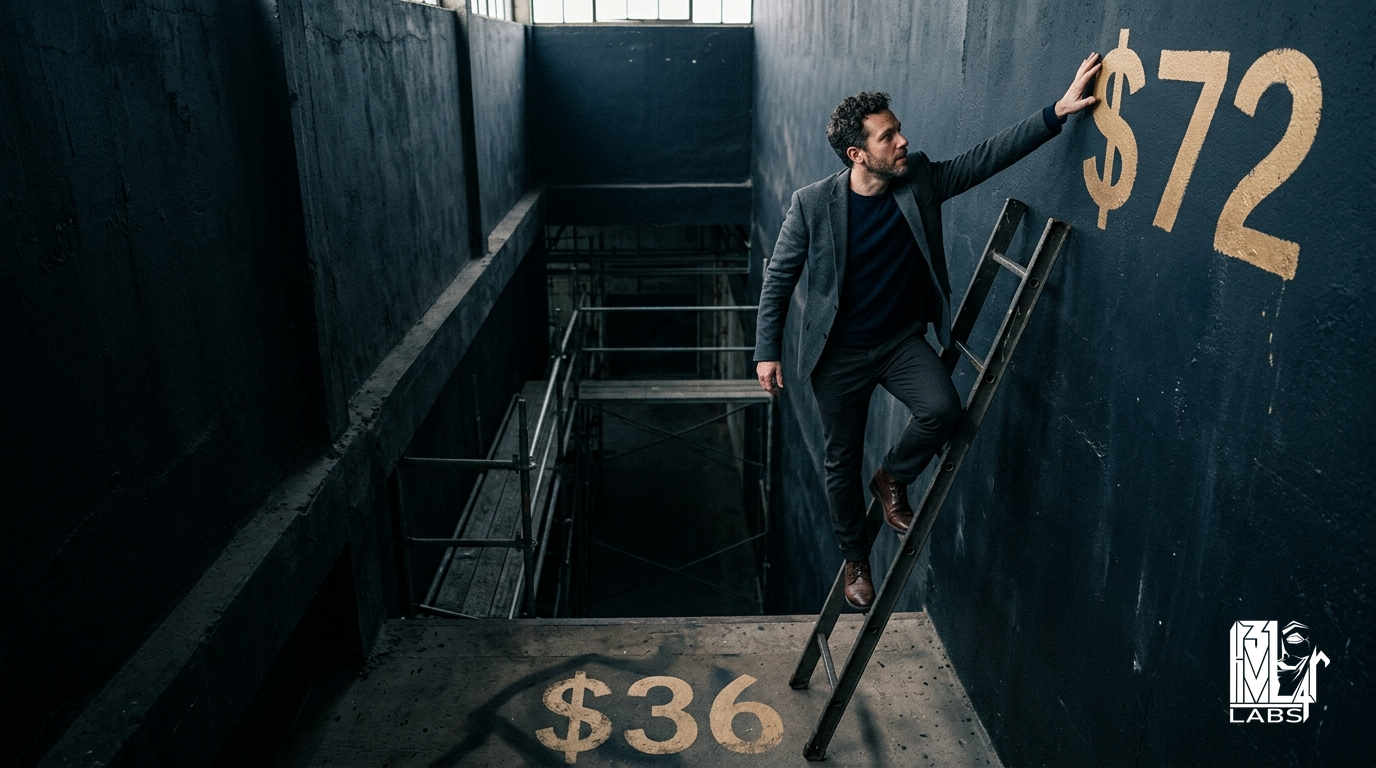
Here's a fun exercise: pull up sixteen analyst price targets on Zillow, average them out to roughly $72, then look at where the stock actually trades. $36. Not $36 after some catastrophic single-day gap — just... where it's been sitting. That's not a valuation gap, that's a canyon. And when Wall Street's models are off by 100% on a stock that's already down 57% year-to-date, the interesting question isn't "when does Z catch up to the targets." It's "why does anyone still believe the targets."
Let's start with the mess that is Zillow's earnings picture, because it's genuinely confusing and that confusion is itself informative. Q1 2026 was a clean beat — $0.53 EPS against $0.43 expected, revenue of $708 million, the kind of print that gets Zacks to slap a Strong Buy rating on the name. Great. Then, within the last day of this writing, another number lands: $0.20 EPS, missing estimates by 24 cents. If that's Q2, we just watched profitability get cut by more than half in a single quarter. That's not noise, that's a trend line pointing the wrong direction, and it should make you deeply skeptical of anyone still waving around a $60-$105 price target as if the Q1 beat was the start of something.
The Analysts Are Cutting — Just Not Enough
Notice what's actually happening beneath the "Moderate Buy" veneer. Jefferies didn't drop coverage, but it took its target from $75 to $60. KeyBanc went from $65 to $57. UBS reportedly went all the way from $75 down to $50. These are not bears capitulating — these are bulls quietly admitting the housing market is worse than they modeled a quarter ago. When your "bullish" analysts keep marking down and your stock keeps falling anyway, the market is telling you something the spreadsheets haven't caught up to yet: mortgage rates, transaction volumes, and agent ad spend are all soft, and Zillow's revenue is wired directly into all three.
Layer on a securities fraud lawsuit tied to Redfin deal disclosures, a dual-class structure that leaves Class A holders with second-tier voting rights, and a home price forecast that's basically flatlined at +0.0% over the next 12 months, and you start to understand why the stock refuses to mean-revert toward those lofty targets. The market isn't irrational here — it's pricing in a housing cycle that isn't turning, plus a business whose operating margin is sitting at an anemic 0.48%.
But It's Not All Bad — And That's the Trade
Here's where I push back on pure doom, because the balance sheet doesn't look like a company in crisis. Zillow's sitting on $795 million in cash, debt-to-equity of just 0.10, and free cash flow that rebounded to $285.5 million. A forward P/E of 11.38x on a name that's supposedly building the "operating system" for real estate — Zillow Home Loans, rental platforms, the whole software-monetization pitch — is not an expensive stock if that thesis actually plays out. The technical picture even shows some life: a real uptrend off the June lows, support holding at $32 (the 52-week low) through multiple tests, with resistance up at $38-$40.
So here's my read: this is a battleground stock, not a slam-dunk in either direction, and anyone telling you $72 is a "target" with a straight face hasn't updated for the housing tape we're actually living in. I'd rather trust the chart than the consensus right now — $32 is the line in the sand, and a break below it on confirmation of that ugly $0.20 print invalidates the whole "accumulate" case. Above $32, with earnings power intact and cash on hand, a grind toward $45 on any hint of rate relief or housing stabilization is entirely plausible.
The bottom line: don't buy Zillow because sixteen analysts say it should be worth double. Buy it, if at all, because the balance sheet can survive the wait and the chart is telling you where the real risk line sits. Everything else is noise dressed up as a price target.
More on Z
Market commentary from the K3vl4r desk — not personalized investment advice. More posts →