LEU — AI Stock Forecast & Price Targets
Published 7/10/2026 · A free sample of K3vl4r’s AI-powered analysis.
Kronos price forecasts, scored fundamentals & technicals, and a multi-horizon plan.
View the live LEU price forecast →
Centrus Energy owns a genuinely scarce asset — the only U.S.-licensed HALEU enrichment capability, now backed by a finalized $1.07B DOE contract and imminent S&P SmallCap 600 inclusion — but trades at ~57x trailing / ~64x forward earnings while burning cash ($58.3M Q1 FCF loss) into a binary Aug 4 print. Charts show a well-defined $145-$210 range post the $464 collapse, with 22% short float and 100% retail bullishness creating two-sided risk. HOLD is warranted: the strategic story is intact, but valuation and execution risk cap the reward-to-risk until margin/FCF stabilization is proven.
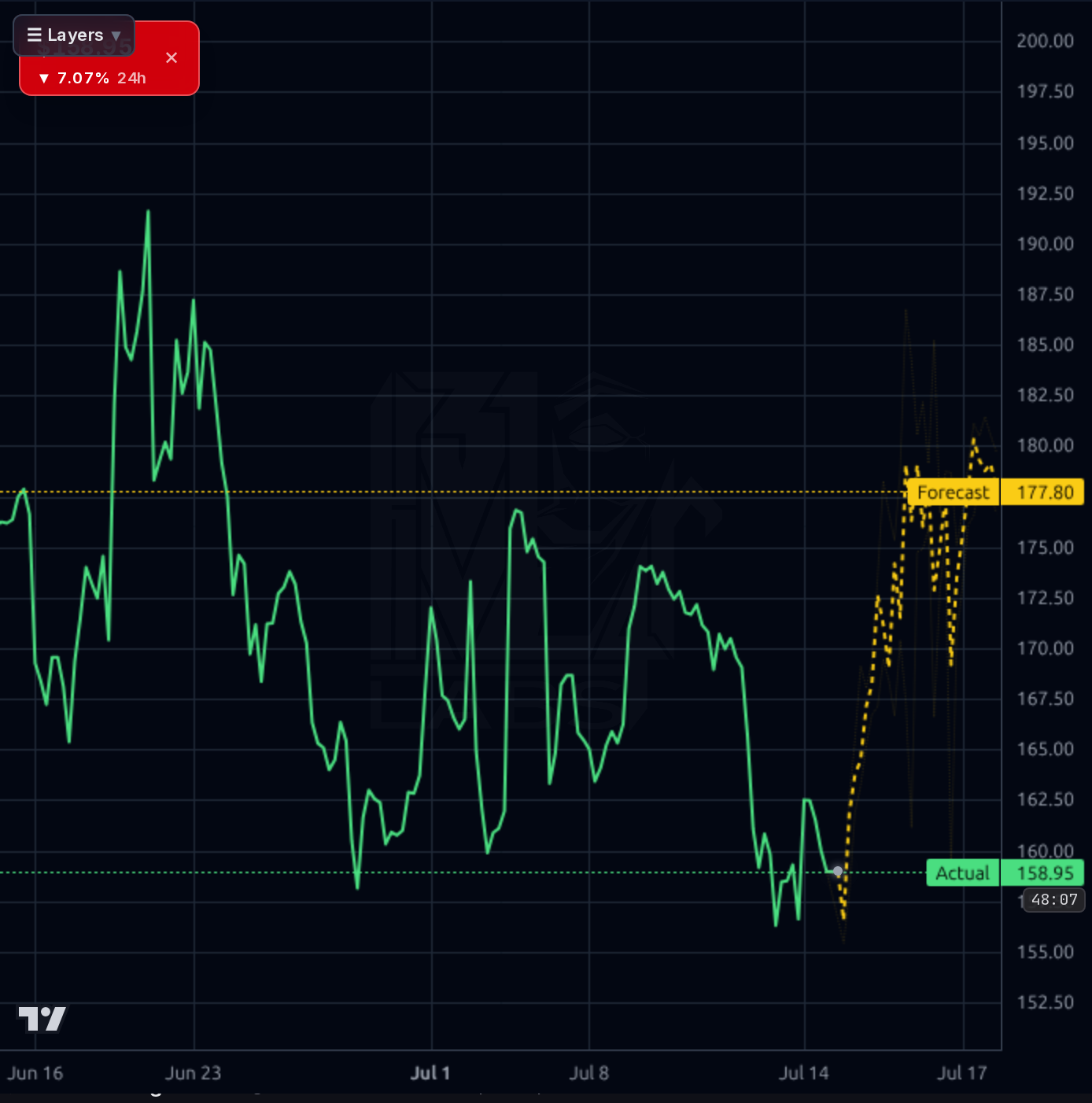
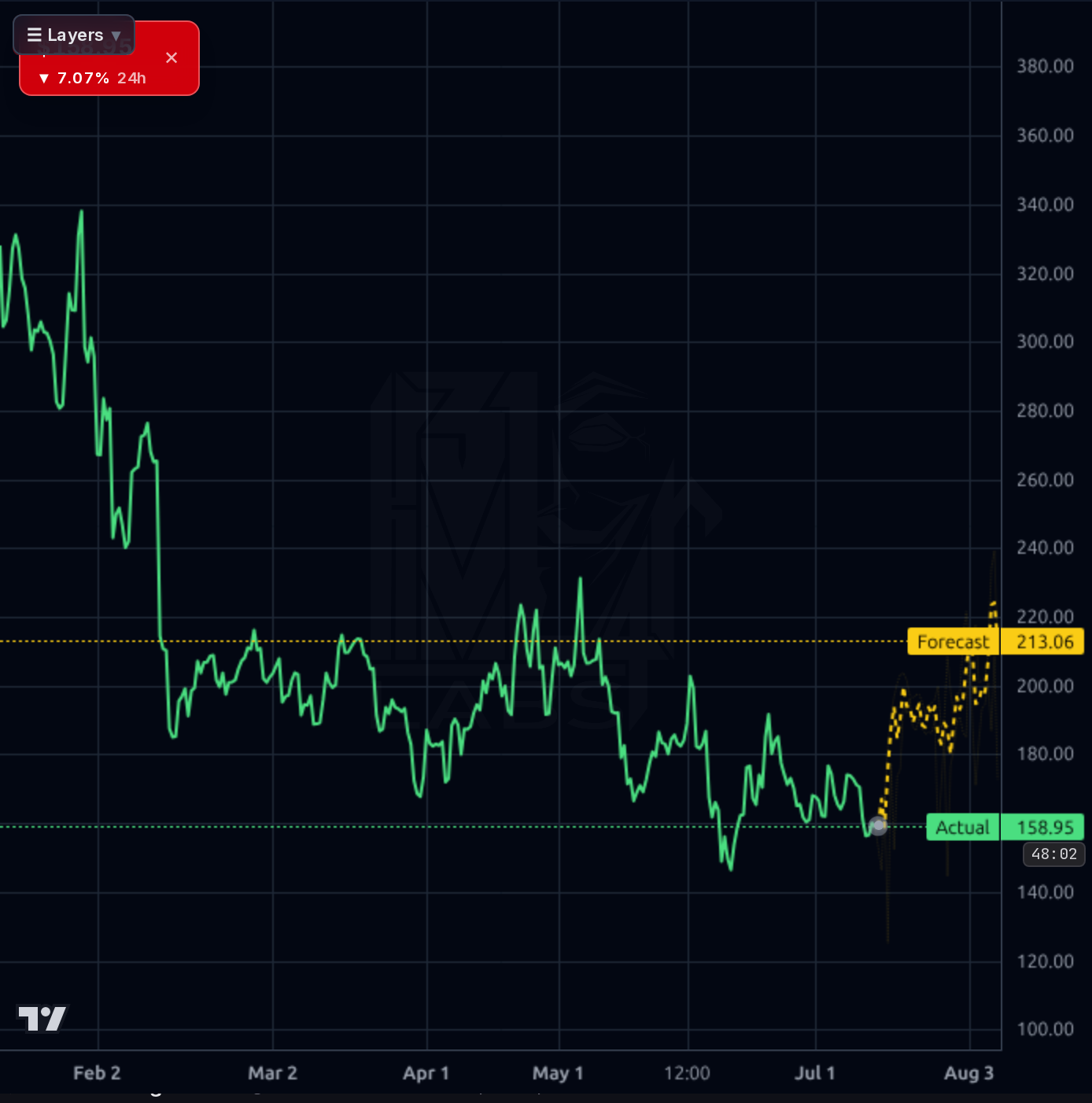
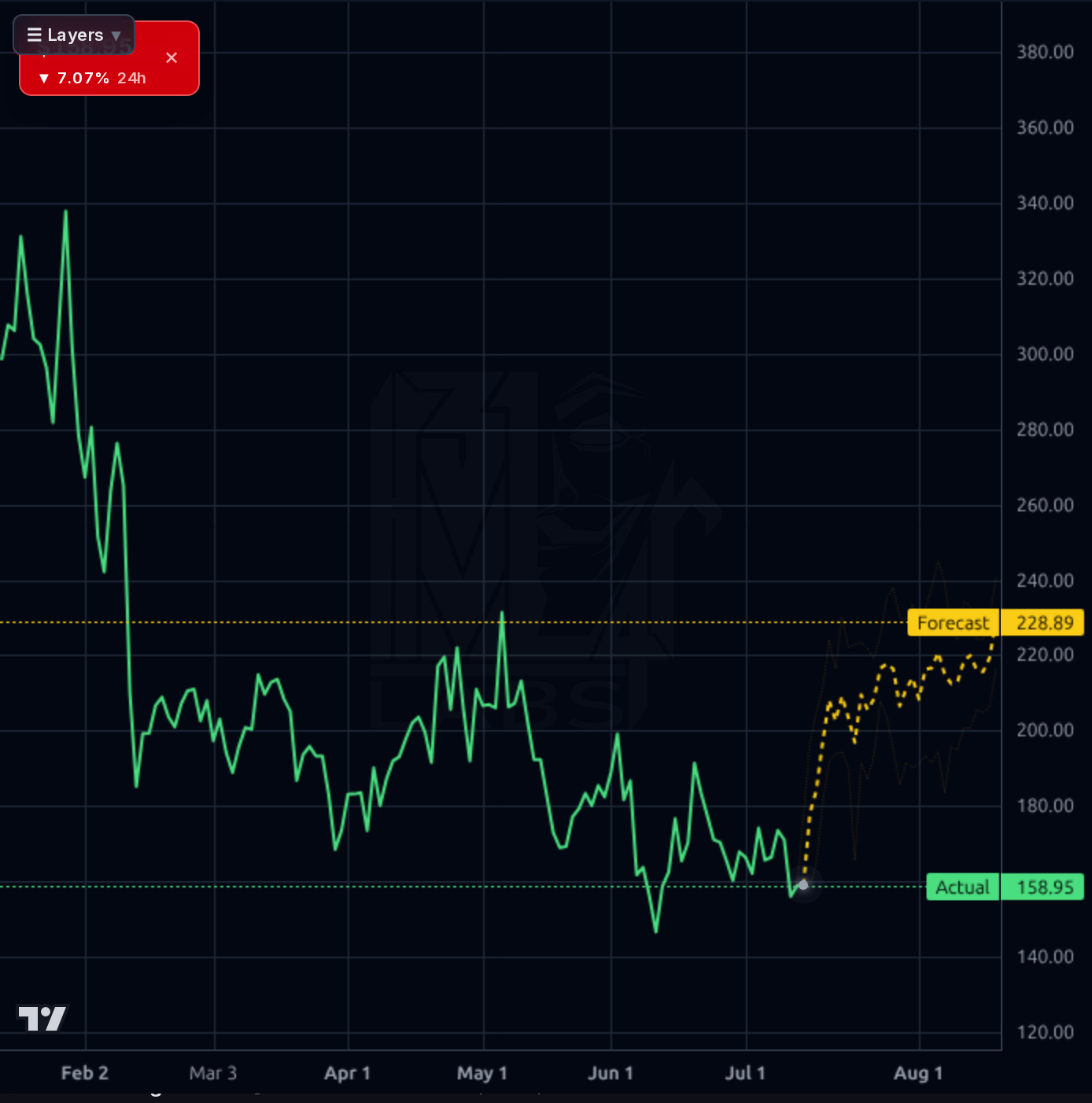
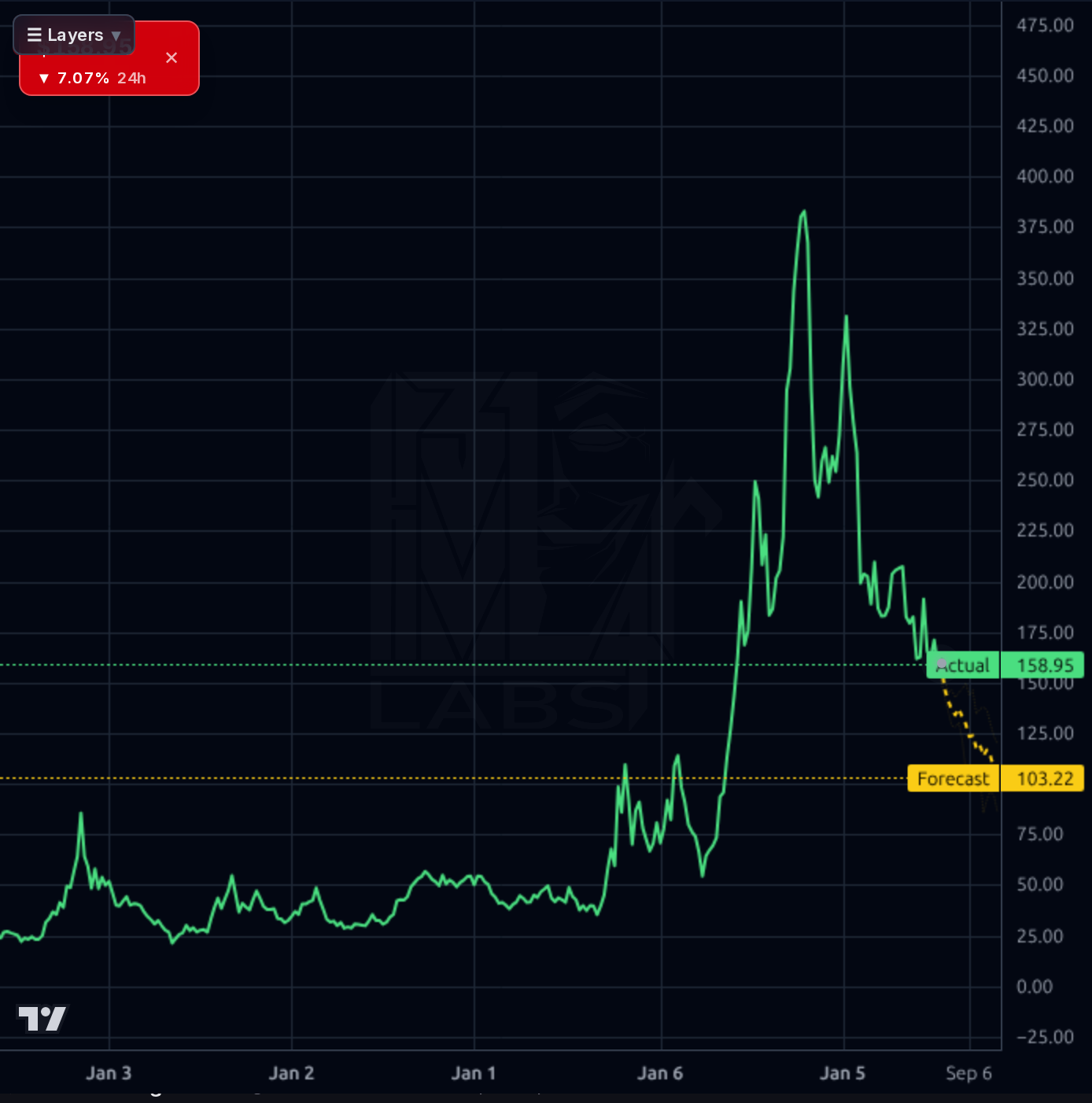
Into Aug 4 earnings (~25 days out), stay flat or hold existing positions — do NOT initiate a directional swing into a binary print with 7.8% daily volatility and 22% short float. Operative levels: $160 must hold for the constructive range case; a close below $155 opens $145 retest. Upside: $185 is stiff resistance (analyst PT cluster), $210 caps the range. Any pre-earnings rally into $190-$210 should be faded/trimmed; a flush to $150-$155 pre-print with no fundamental shock is a tactical add zone. Invalidation: sustained close below $145 breaks the six-month base.
1-6 month view is a HOLD framed by the range. Base case: stock oscillates $150-$210 as DOE revenue recognition ramps unevenly; expected return range is -12% to +21% from $173. Bull case requires Aug 4 to show FCF stabilization guidance and a clear step-up in DOE revenue cadence — that unlocks $210+ and potentially a retest of $240. Bear case: another quarter of >$50M FCF burn with no offtake conversion pushes the stock back to $145 support and possibly $130 if the market decides to derate the multiple. Change my mind: (1) firm Oklo LOI conversion to a revenue-backed offtake, (2) additional DOE task orders beyond current scope, (3) two consecutive quarters of positive operating cash flow.
1-3 year terminal thesis is genuinely asymmetric IF Piketon reaches commercial-scale HALEU output and the advanced reactor cohort (Oklo, TerraPower, X-energy) hits deployment timelines — LEU would be a monopolistic domestic supplier of a strategic input, with revenue potentially multiples of the current $452M base. Multi-year drivers: U.S. energy security policy, restart of dormant reactors, SMR/advanced reactor buildout, potential Russia enrichment ban tailwinds. Biggest structural risk: HALEU demand curve slips 2-3 years (advanced reactor delays are the norm), extending cash burn beyond what the balance sheet comfortably supports, forcing dilution at lower prices. Secondary risk: competition from restarted government enrichment or foreign supply once the Russia dependency issue eases.
The story is bifurcated. On the strategic side, LEU is the sole U.S.-licensed HALEU enricher with a finalized $900M task order inside a $1.07B DOE enrichment agreement, a fortress balance sheet ($1.87B cash, $94.97/share, current ratio 5.72), and 71.5% institutional ownership — real institutional endorsement of the moat. On the operating side, the picture is deteriorating: Q1 2026 revenue was just $76.7M (vs $154.5M in Q2 2025 and $146.2M in Q4 2025), gross margin swung to 41.1% in Q1 2026 but was -5.7% in Q3 2025 — that lumpiness undermines any steady-state modeling. Free cash flow has now been negative for two consecutive quarters (-$58M in Q4 2025, -$58.3M in Q1 2026) as capex ramps ($23.2M in Q1). TTM revenue at $452M is down 4% Y/Y, EPS Q/Q is -72%, and forward P/E of 64x with a negative 5Y EPS growth estimate (-19%) makes the multiple hard to defend on numbers alone. Debt-to-equity of 152% is elevated but manageable given the cash pile (net cash position). Capital allocation is defensible — cash is being deployed into the Piketon commercial ramp rather than dividends/buybacks — but investors are effectively funding a multi-year build with no dividend and negative FCF.
Across timeframes the structure is a wide, choppy range post-collapse from the $464 high. The 1D chart shows a lower-high sequence from ~$240 down to a $145 low, then a bounce to current $170-$173, with the forecast band pointing to $199 (~+15%) — meaningful but well inside the established range. The 4H shows a sharp July rally from $145 to ~$220 followed by a distribution top and a slide back to $173; forecast band drifts up to $222 but the model's directional accuracy at longer horizons (25-45% vs naive 70-85%) means that longer forecast leg should be discounted heavily. The 1H is coiling in a $160-$180 zone with forecast at $164 — essentially sideways. Key levels: support $160/$145 (52w low), resistance $185 (analyst target zone), then $210 (top of range). RSI 50.6, SMA20 +2.8%, SMA50 -4.3%, SMA200 -28.8% — a neutral short-term posture within a broken long-term trend. 22.3% short float plus 100% retail bullishness is a classic setup for whipsaw around the Aug 4 print. Notable divergence: the 1D forecast is more constructive than the 4H/1H, but model reliability is worst at exactly those medium horizons.
The signal is the July 8 finalization of the $900M DOE task order (inside a $1.07B enrichment agreement) formalizing the commercial-scale HALEU transition at Piketon, plus S&P SmallCap 600 inclusion effective July 14 — a mechanical demand catalyst for index buyers. The 8-K stack (material agreement July 2, executive change/other material events June 18) is consistent with contract execution rather than distress. The noise cuts both ways: on July 9 both Needham (Buy, $314 → $264) and BofA (Neutral, $240 → $205) cut price targets, indicating even bulls are trimming expectations. A Simply Wall St piece flagging the stock as potentially 71% undervalued and a Zacks retrospective are promotional in tone and should be discounted. Retail chatter is uniformly bullish but frustrated ('is this donkey ever gonna move'), a contrarian caution flag near range highs.
- $900M DOE task order (finalized July 8) inside a $1.07B enrichment agreement transitioning Piketon from demonstration to commercial-scale HALEU production
- S&P SmallCap 600 index inclusion effective July 14 creating mechanical passive/institutional demand
- Oklo Letter of Intent providing optionality on advanced reactor fuel offtake — conversion to firm contract is the key upgrade catalyst
- $1.87B cash position ($94.97/share) funds multi-year Piketon ramp without near-term dilution risk
- Q1 2026 gross margin recovery to 41.1% (from -5.7% in Q3 2025) suggests emerging pricing/mix leverage if sustained
- Aug 4 earnings print as first opportunity to show FCF stabilization guidance and DOE revenue recognition cadence
- Forward P/E ~64x with a NEGATIVE 5Y EPS growth estimate (-19%) leaves no valuation cushion for execution slippage
- Free cash flow burn accelerating: -$58M Q4 2025 and -$58.3M Q1 2026, with capex still ramping ($23.2M Q1)
- Extreme gross margin lumpiness (-5.7% to +41.1% across four quarters) makes steady-state economics unmodelable
- Both Needham and BofA cut price targets on July 9 (Needham $314→$264, BofA $240→$205) signaling sell-side derating
- 22.3% short float combined with 100% retail bullish sentiment creates two-sided whipsaw risk into Aug 4 earnings
- TTM revenue down 4% Y/Y and EPS Q/Q -72% — the near-term operating trajectory is weakening, not strengthening
- HALEU commercial demand ultimately depends on advanced reactor deployment timelines, which historically slip
- Debt-to-equity at 152% is elevated even with cash offset; a prolonged burn could pressure the capital structure
Get AI analysis on any stock
This is one of hundreds of Kronos AI reports — scored fundamentals & technicals, bull/base/bear price targets, a multi-horizon plan, and continuously-updated forecasts across the market. Create a free account to explore them all.
Create your free account →Already a member? Sign in · Join our Discord