LYG — AI Stock Forecast & Price Targets
Published 6/14/2026 · A free sample of K3vl4r’s AI-powered analysis.
Kronos price forecasts, scored fundamentals & technicals, and a multi-horizon plan.
View the live LYG price forecast →
Lloyds Banking Group (LYG ADR) trades at $5.50, up 30% over the past year and within 13% of its 52-week high of $6.34, supported by improving EPS (Q/Q +54.9%), a 13.1x trailing P/E, 8.3x forward P/E, and analyst Recom of 1.79 with a $6.51 target. However, the Kronos AI forecasts across 1d and 1wk timeframes project a meaningful drawdown toward $4.78 and $3.40 respectively, suggesting the market may be late-cycle on UK banks even as fundamentals look reasonable. Net: a quality income name at a fair-to-cheap multiple, but technically extended into resistance with model-implied mean reversion risk — appropriate for ACCUMULATE on weakness rather than chasing here.


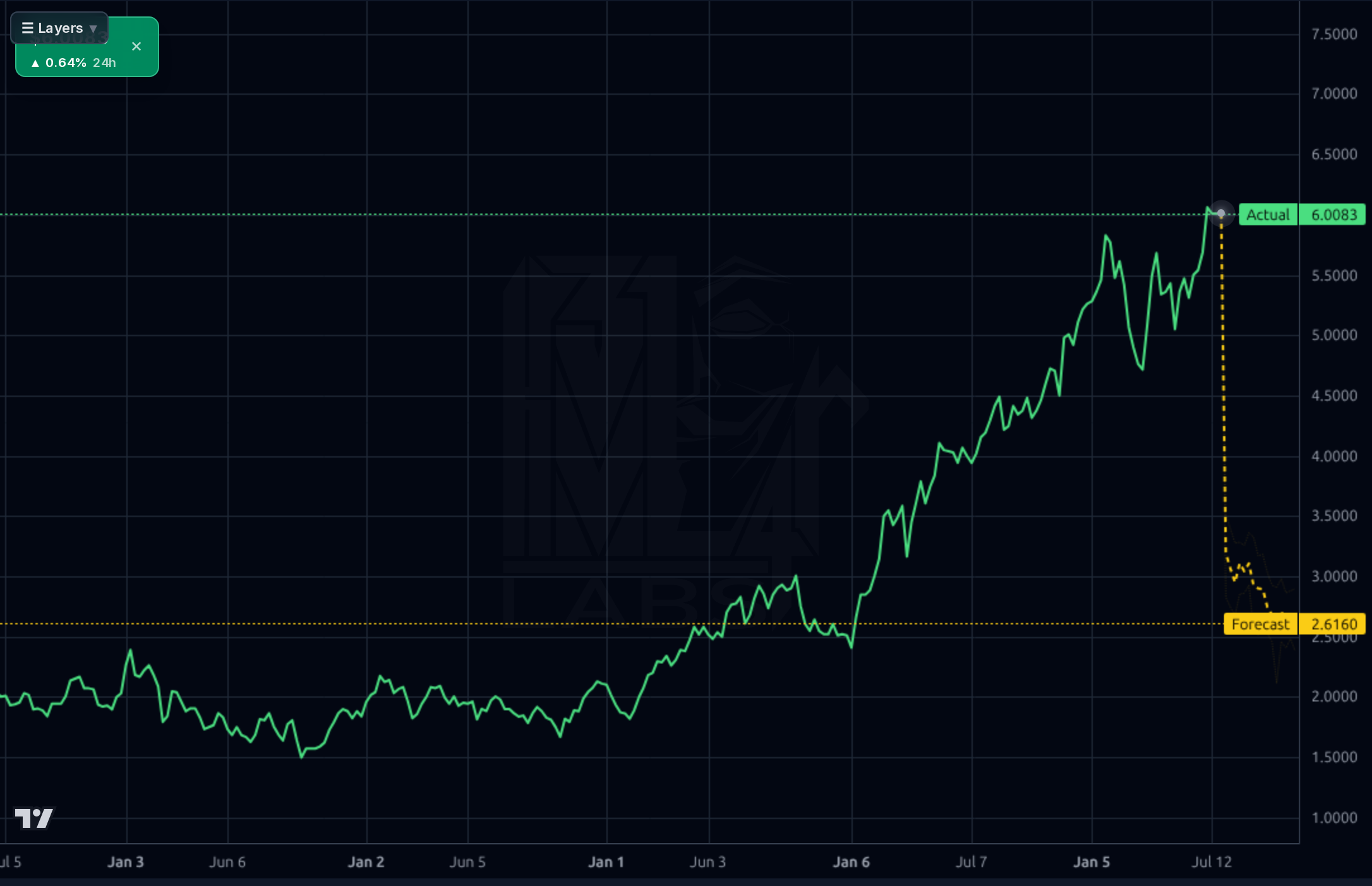
1–4 week view: Neutral-to-cautious. Price is mid-range and the Kronos 1h/4h/1d forecasts skew bearish into July. Wait for either (a) a clean break and hold above £5.80 with volume to chase, or (b) a pullback to £5.00–5.10 to add. Invalidation of bullish stance: weekly close below £4.80. Avoid full-size entries at current £5.50 given proximity to resistance and forecast asymmetry. Position size: 1/3 of intended weight if initiating.
1–6 month view: Constructive on fundamentals (forward P/E 8.3x, PEG 0.32, 3.6% yield, 22% 3Y dividend CAGR, EPS Q/Q +54.9%) but technically the stock has already priced in a lot of the UK bank re-rating. Expected return range: -10% to +15% over 6 months, with the Kronos model implying the downside scenario is more probable near-term. Catalysts: Q2 earnings (next earnings cycle), BoE rate path (NIM sensitivity), any buyback announcement. Would change my mind: a hawkish BoE surprise that lifts NIM guidance, or evidence of UK loan growth re-accelerating beyond consensus.
1–3 year view: Lloyds is a high-quality, deposit-rich, capital-return story (P/B 1.27, ROE ~10%, 53% payout, double-digit dividend growth) leveraged to UK consumer/SME credit. Multi-year drivers: structural cost-out (branch closures), digital/Stripe partnerships, mortgage book repricing, and capital returns. Biggest structural risk: UK macro fragility — a credit cycle turn would expose the 20x asset/equity leverage, and the Kronos 1wk model implying a regression toward £1.50–3.40 is consistent with a recession scenario. Long-term total return likely 8–12% annualized (dividend + modest re-rating) under base case, materially lower in a UK recession.
Lloyds shows a constructive earnings trajectory: quarterly net income rose from £1.385B (Q2'25) to £1.402B (Q4'25) to £1.531B (Q1'26), with Q1'26 net margin at 29.5% — a sharp improvement from 16.2% in Q3'25. TTM EPS is £0.42 with EPS Q/Q +54.9% and EPS Y/Y TTM +29.8%, and Finviz lists 'EPS next 5Y' at 25.8% which feels optimistic but reflects buyback-aided per-share leverage. Valuation is undemanding: trailing P/E 13.1x, forward P/E 8.3–10.3x, P/B 1.27, PEG 0.32, with a 3.6% dividend yield (payout ~53%) and dividend growth of 22%/46% over 3/5Y. Balance sheet is typical UK universal bank — total assets £968B, equity £48B (leverage ~20x), Debt/Eq 3.11 — solid but inherently sensitive to NIM and credit cycle. ROE 9.9% and ROA 0.50% are middling for a regional bank; operating margin 35–41% is healthy. Weak spots: Sales Y/Y TTM is reported as -15.15% (likely revenue-mix/NIM normalization), institutional ownership shown as only 4.22% (ADR-specific quirk), and no free cash flow disclosure — typical for banks but limits cash-quality assessment. Capital allocation has been shareholder-friendly via dividends and (implied) buybacks, but branch closures (245 across 2026–27) signal cost-cutting pressure rather than top-line growth.
On the 1wk chart, LYG has rallied from ~£1.50 in mid-2024 to £5.50, more than tripling — an exceptional multi-year breakout, but the price action since early 2026 shows a lower high vs. the ~£6.00+ February peak (visible on the 1d chart at ~£6.20) and is now consolidating near the £5.50 mid-range. The 1d chart shows a choppy range between ~£4.80 support (April low) and ~£6.20 resistance, with current price sitting in the upper half. RSI at 55.9 is neutral-bullish; price is 2.7%/2.3%/7.3% above SMA20/50/200 — trend intact but not stretched. The Kronos forecast is the standout concern: the 1d model projects a roll-over from ~£5.25 down to a £3.70–4.00 trough by October before recovering to £4.78 by December, and the 1wk model projects a steeper move to £1.50 by late-2027. While AI forecasts on long horizons are speculative, the consistent bearish skew across both 1d and 1wk timeframes is a yellow flag — particularly given the parabolic 2024–2026 run is statistically prone to mean reversion. Key levels: support £4.80 then £4.40; resistance £6.00 then £6.34 (52wk high).
Signal: Lloyds is in a value-extraction phase rather than a growth phase. The 245 branch closures across 2026–27 (Moneyweek, June 12) confirm aggressive cost takeout, while the Stripe partnership for SMB payments (June 10) is a modest but real fintech-adjacent revenue add. Multiple Simply Wall St. valuation pieces (June 10, May 27) note the 34.98% 1-year total shareholder return and frame valuation as worth re-examining — typical late-cycle 'is it still cheap?' coverage. The dividend-stock framing (June 2) reinforces income-investor crowding, which can compress upside. Noise/negative: Two separate app outages in early June (Lloyds/Halifax/Bank of Scotland) following an earlier IT incident impacting ~500K customers are a reputational and operational-resilience concern but not financially material in isolation. The broader market headlines (Bitcoin, SpaceX perps, Iran diaspora) are unrelated. Net news tone: neutral-to-slightly-positive on fundamentals, with operational reliability as a watch item.
- Cost takeout via 245 announced branch closures in 2026–27 (Moneyweek, June 12) supports operating margin expansion from current 36–41%
- Stripe Connect partnership embedded into Lloyds/Bank of Scotland Business Accounts (June 10) opens SMB payments fee revenue stream
- Dividend growth of 22% (3Y) and 46% (5Y) with 53% payout ratio leaves room for continued capital returns; forward dividend estimate $0.23 (4.21%)
- Forward P/E compression from 13.1x to 8.3x implies consensus expects EPS growth into 2027; EPS next 5Y estimated at 25.8%
- Q1'26 net margin of 29.5% vs. 16.2% in Q3'25 suggests NIM and credit cost normalization tailwinds remain in play
- Kronos AI 1d forecast projects a drawdown to ~£3.70–4.00 trough into Q4 2026 with a £4.78 endpoint — material mean-reversion risk after the ~3.7x run from 2024 lows
- Recurring IT outages (June 3 app outage following earlier ~500K customer incident) raise operational resilience and potential regulatory scrutiny
- Sales Y/Y TTM at -15.15% per Finviz suggests revenue headwinds despite EPS growth — earnings quality partly driven by lower provisions/cost cuts, not top-line
- 20x asset/equity leverage and UK consumer-credit concentration make Lloyds highly cyclical; any UK recession would compress book value and dividends
- Stock is up 30% in 1 year and 146% over 3 years — much of the easy re-rating is done; analyst target of £6.51 implies only ~18% upside
- Branch closures and motor-finance/PPI-style consumer-redress overhangs remain latent regulatory risks for UK banks
- Institutional ownership reported at only 4.22% (ADR-specific) limits read-through on sponsorship; primary listing is LSE
Get AI analysis on any stock
This is one of hundreds of Kronos AI reports — scored fundamentals & technicals, bull/base/bear price targets, a multi-horizon plan, and continuously-updated forecasts across the market. Create a free account to explore them all.
Create your free account →Already a member? Sign in · Join our Discord