TIGR — AI Stock Forecast & Price Targets
Published 7/29/2026 · A free sample of K3vl4r’s AI-powered analysis.
Kronos price forecasts, scored fundamentals & technicals, and a multi-horizon plan.
View the live TIGR price forecast →
TIGR trades at $4.80, ~1x book and 5.1x forward P/E, with durable 26%+ revenue growth and 41-49% operating margins — but a Q1 2026 net loss of -$26.9M broke a 3-quarter streak of $41-54M profits, leaving the stock -65% off highs and range-bound $4.40-$5.00 for 8+ weeks. The Aug 27 print is the binary arbiter: either the loss is boxed as a one-off non-operating item and the multiple re-rates, or it recurs and the current valuation is a value trap. HOLD into the print — cheap enough to not sell into a bottom, but no edge to add before a binary catalyst.
Hold. Do not size a swing into the Aug 27 print (~29 days out) — expect a gap and IV crush either direction. If flat and hunting a tactical entry, prefer accumulation at $4.20-4.35 with a $3.95 stop (below the $4.00 floor); do not chase into $4.90-5.00 resistance. Trigger to lean bullish pre-print: reclaim of $5.00 on relative volume >1.5x. Invalidation: any daily close below $4.00 breaks the 8-week base and re-opens $3.50.
The Aug 27 earnings print is the whole thesis over 1-6 months. If Q1 net loss is explicitly disclosed as a one-off non-operating charge and Q2 net income returns to a $40-55M run-rate, the 5.1x forward P/E and 1x book re-rate toward $5.75-6.75 is credible over 3-6 months; if the loss recurs or is unexplained, the value-trap read wins and $3.50-4.00 becomes the operating range. Expected return range from $4.80: -25% to +30%, skewed by the binary. What changes my mind post-print: (a) a buyback authorization at ~1x book would be highly accretive and a strong signal; (b) a management disclosure that ringfences the Q1 charge; (c) any China regulatory enforcement headline against offshore brokers (bearish).
Terminal thesis: TIGR is a scalable digital brokerage/wealth platform with 66-70% gross and 41-49% operating margins, 40%+ 3Y sales CAGR, and diversification into wealth, ESOP, IPO underwriting, and fund structuring that reduces pure brokerage cyclicality. If it can compound revenue at 20-25% with net margins normalizing at 20-25%, the current ~$860M market cap is materially undervalued vs. $2-3B fair value over 2-3 years. Biggest structural risk is PRC/Chinese-user regulatory action against offshore digital brokers — an existential, un-hedgeable tail — followed by the customer-fund-liability structure (trust-event risk). A patient long owning a 1-1.5% position sized to absorb a 30-40% drawdown is defensible; a levered or concentrated position is not.
The operating business remains healthy: Q1 2026 revenue $154.9M (+26.5% Y/Y), gross margin 66.5%, operating margin 42.4%, operating income $65.7M — all consistent with the prior three quarters (op margins 41-49%). The break is at the net line: -$26.9M vs. +$41M/+$54M/+$45M in the prior three quarters, with EBITDA collapsing to $4.3M, strongly suggesting a large non-operating/one-off charge (write-down, mark-to-market, or investment loss) rather than core deterioration — but management has not formally disclosed it as such. Balance sheet is fortress-like on the surface: $4.5B total cash, $596M corporate cash, only $66M debt, book value $4.49/sh (P/B 1.07); however $8.0B of $8.9B liabilities are customer segregated funds, so the trust/franchise risk profile is highly asymmetric. Capital allocation is the puzzle — no buyback despite trading at ~1x book with ample corporate cash, which either signals discipline before earnings clarity or an undisclosed liability. Forward EPS revisions (+46% → +54% → +64% over ~45 days) diverge from sell-side price target cuts ($16.80 → $7.68 → $6.99), and estimate revisions have historically been the leading signal here.
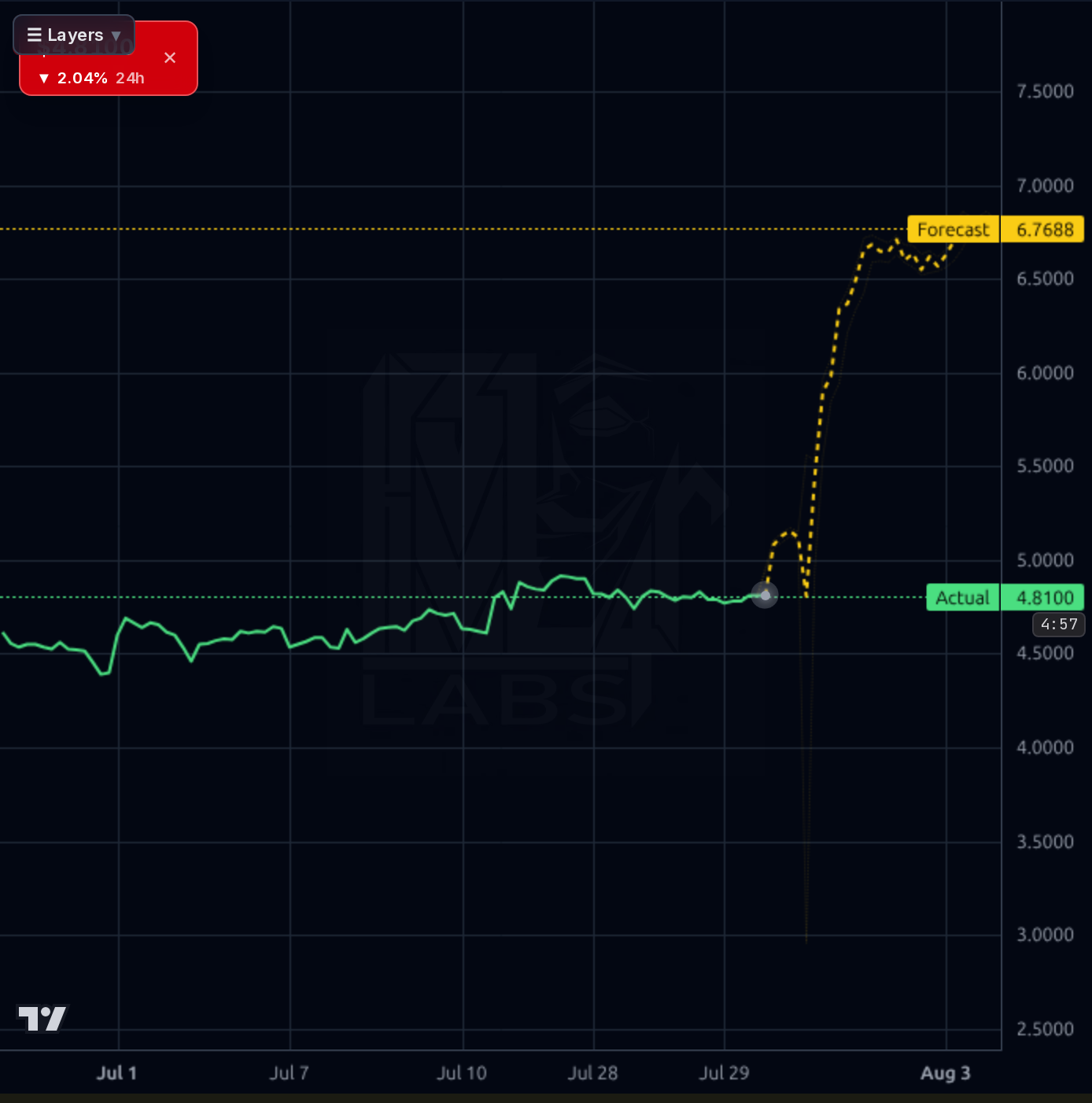
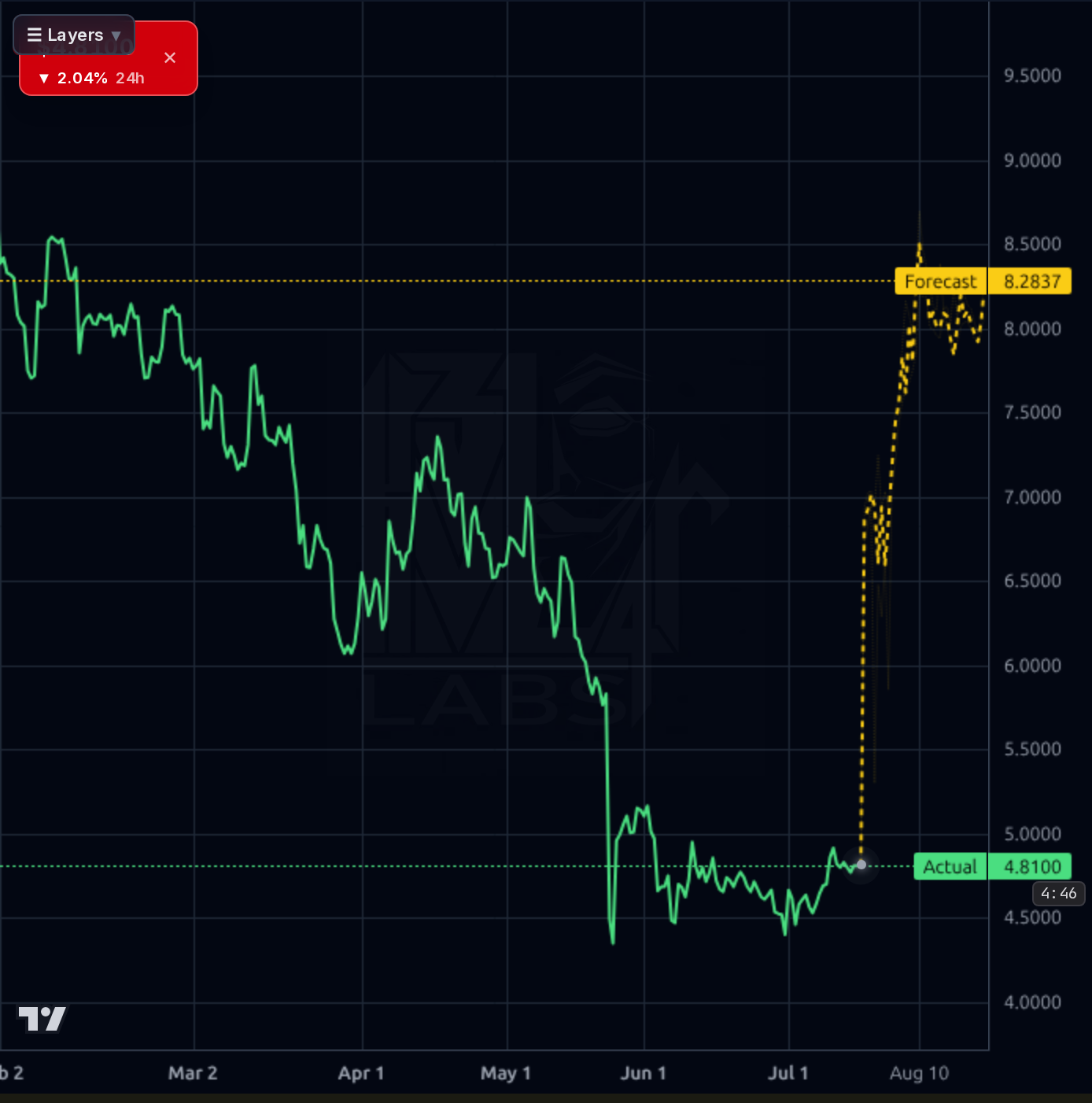
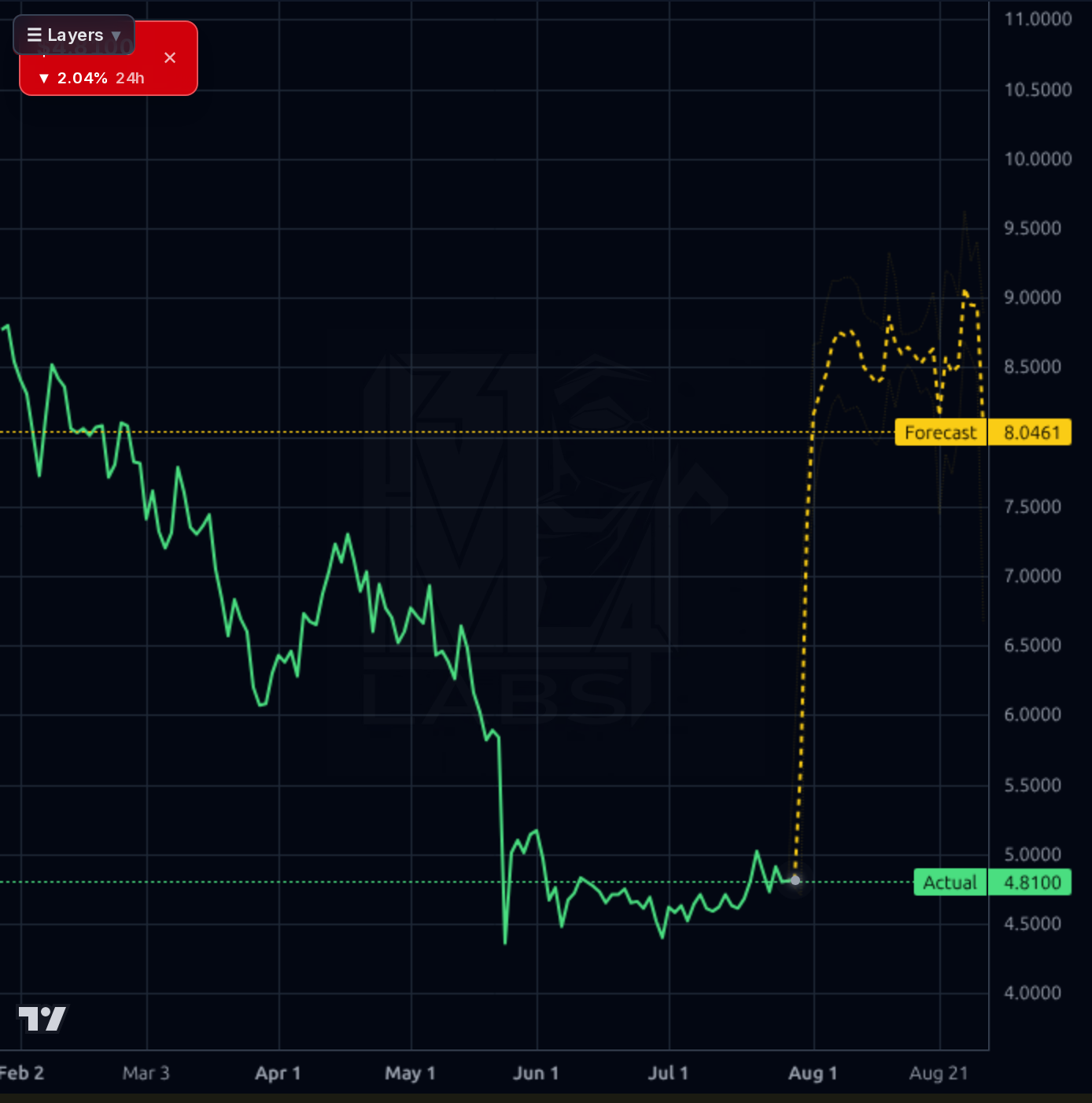
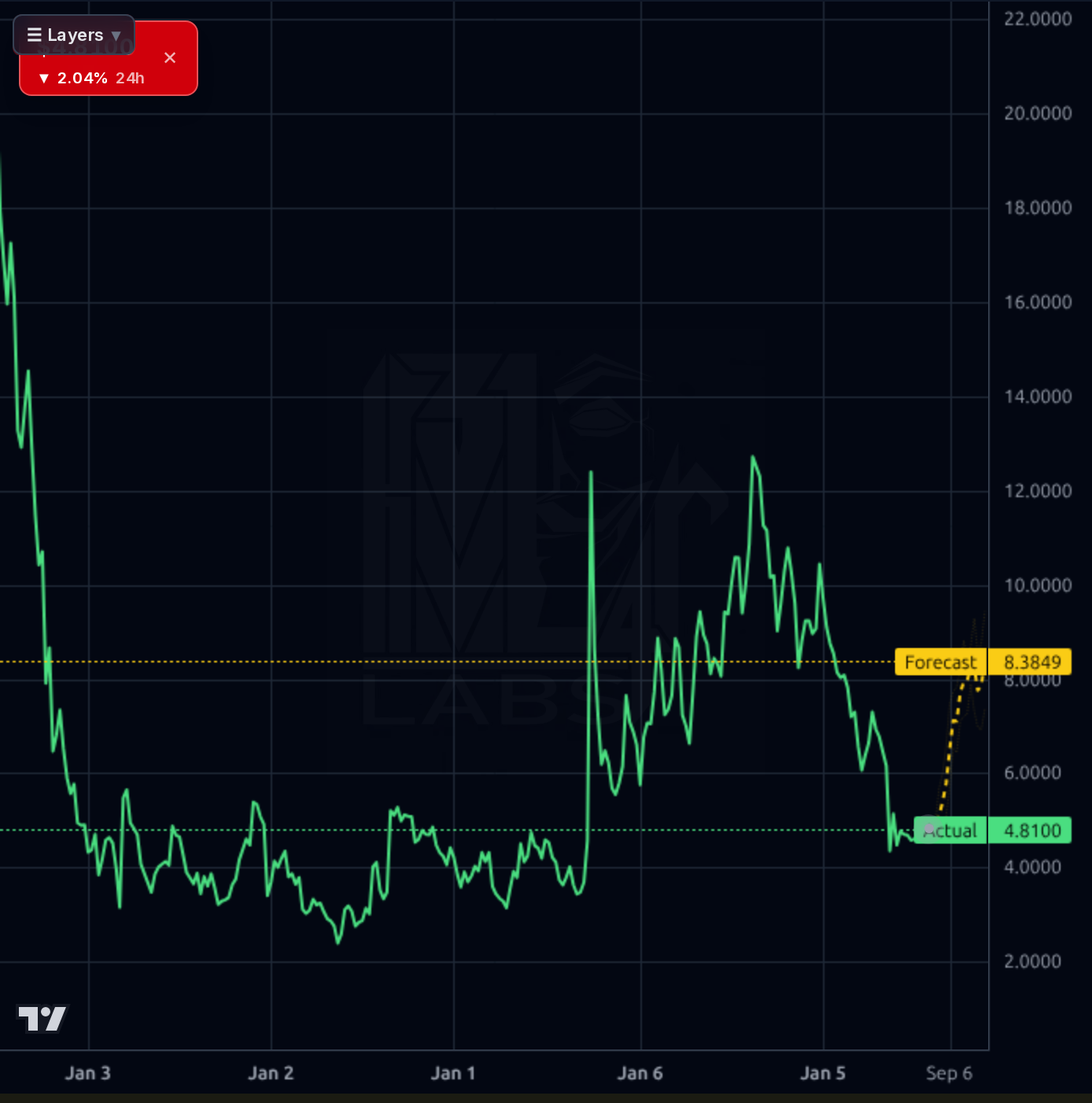
The stock is in a stage-4 downtrend on the daily/weekly (SMA200 -35.8%, 52W high -64.6%, YTD -49.8%) but has stabilized in a tight $4.40-$5.00 range for 8+ weeks with $4.00 as twice-tested hard support. RSI 50.4 is neutral, SMA20 +2.5% and SMA50 -1.1% show short-term basing, and the -2.24% daily change against a 24h -2.04% quote suggests low-conviction drift. Resistance stacks at $4.90-5.00, then $5.30, then the $6.50 gap-fill zone. The model's forecast bands ($6.77 on 1h, $8.28 on 4h, $8.05 on 1d, $8.38 on 1wk) are aggressive and unreliable in this regime — 1-week directional accuracy 67% is BEATEN by the 83% naive baseline, and MAPE runs high; treat those yellow lines as noise, not objectives. On the weekly, the current $4.80 sits just above the pandemic-era bottom cluster, which is meaningful long-term support but does not equal an imminent reversal without a catalyst.
Direct newsflow is thin but net-positive at the margin: TIGR received a 'Moderate Buy' consensus (1 sell, majority not sell) per a July 26 aggregator, and Tiger Brokers was named to CNBC's World's Top FinTech Companies 2026 for the second consecutive year — a franchise signal that plays against the China-broker-blowup narrative. Neither headline is a catalyst; the binary is the Aug 27 print. Macro backdrop is neutral (transitional regime, SPY late markup/distribution, defensive leadership), which does not particularly help a levered-to-retail-activity, China-adjacent name. Geopolitical items (Houthi Red Sea fees, US-Iran) are noise for this ticker. The material fundamental-change signals are the +7.8pp then +10pp bumps in next-year EPS estimates (bullish) offset by a -9% price target cut to $6.99 (bearish) — the divergence continues.
- Aug 27 Q2 print: management disclosure separating the -$26.9M Q1 net loss from underlying operating earnings power (op income was $65.7M, EBITDA collapsed to $4.3M — strongly suggests non-operating charge)
- Next-year EPS estimates revised up +64% over ~45 days despite falling sell-side price targets — leading indicator of an EPS-driven re-rate if the Q2 print confirms
- CNBC World's Top FinTech Companies 2026 recognition (second consecutive year) supports franchise durability and non-brokerage revenue expansion (wealth management, ESOP, IPO underwriting)
- Multi-jurisdictional licensing (Singapore HQ, NZ, Cayman, US) continuing to reduce China concentration in the revenue mix
- Potential buyback authorization at ~1x book with $596M corporate cash vs $66M debt — highly accretive if announced
- Aug 27 earnings is a binary catalyst: if Q1 -$26.9M net loss recurs and is not disclosed as one-off, the forward multiple is a value trap and $3.50-4.00 opens
- $8.0B of $8.9B liabilities are customer segregated funds — any trust/franchise/enforcement event is asymmetric and potentially existential
- China regulatory concentration: PRC enforcement against offshore digital brokers can shift without warning
- Sell-side derating momentum (targets cut from $16.80 to $6.99 consensus) can precede further estimate cuts if the print disappoints
- No buyback despite ~1x book and ample corporate cash may signal an undisclosed liability or ringfenced capital
- Severe trend damage: -65% from 52W high, -35.8% below SMA200 — mean reversion typically takes multiple quarters even with a clean catalyst
- The model's own forecast is unreliable in this regime (1wk directional accuracy 67% BEATEN by 83% naive baseline) — do not use its $8+ bands as objectives
Get AI analysis on any stock
This is one of hundreds of Kronos AI reports — scored fundamentals & technicals, bull/base/bear price targets, a multi-horizon plan, and continuously-updated forecasts across the market. Create a free account to explore them all.
Create your free account →Already a member? Sign in · Join our Discord