UPST — AI Stock Forecast & Price Targets
Published 7/24/2026 · A free sample of K3vl4r’s AI-powered analysis.
Kronos price forecasts, scored fundamentals & technicals, and a multi-horizon plan.
View the live UPST price forecast →
UPST has broken the $31 structural support and now trades at $27.59, sitting just 15% above its 52-week low with RSI 33.9 and below all major SMAs heading into a binary Aug 4 earnings print. The tension remains unchanged — reaccelerating revenue (+58% TTM, +44% Q/Q) and OCC conditional approval for Upstart Bank versus -$133M Q1 OCF, 71x trailing P/E, and 31.5% short float creating squeeze/collapse asymmetry. HOLD/AVOID pre-print; the internal 1d/1wk forecast is beaten by naive baseline and prior bull targets above $40 have systematically failed to print.
HOLD/AVOID into Aug 4 AMC earnings (~11 days). Do NOT initiate a directional swing trade — 31.5% short float + binary print creates a coin-flip with fat tails in both directions. If already long, the stop is $23.97 (52w low); a break here likely accelerates to $20. Resistance is $31 (broken support flip) and $33 (SMA50 area). Any pre-earnings rally into $30-31 is a trim opportunity, not a breakout. Explicit earnings stance: sidelined; conviction to short is undermined by squeeze risk, conviction to buy is undermined by -$133M OCF and 71x P/E. IV crush post-print will punish long options regardless of direction.
1-6 month view is HOLD with a bearish tilt unless Q2 delivers positive OCF AND GAAP net income simultaneously. The Aug 20 ABS 2026-3 pricing is the second gate — tight spreads validate the funding channel, wide spreads confirm credit-cycle concerns. Base case: post-earnings volatility resolves in a $25-32 range with the stock unable to reclaim $35 without a clean profitability inflection. Bull scenario requires (1) OCF turning positive, (2) ABS spreads tight, and (3) bank charter milestones progressing — only then does $37-40 come back into view. Bear scenario is a soft print + wide ABS spreads driving a break of $23.97 toward $20. What changes my mind: two consecutive quarters of positive OCF would force a re-rating.
1-3 year terminal thesis rests on whether Upstart Bank actually materializes and whether the AI underwriting moat holds through a full credit cycle. If the charter is granted and cost-of-funds compresses meaningfully, UPST could re-rate to a specialty-lender multiple (10-15x forward earnings on a normalized $3-4 EPS base) — that's a $40-60 stock. If the charter stalls, ABS demand tightens in a downturn, or credit performance deteriorates, UPST reverts to the balance-sheet-constrained fintech it structurally is, and the equity is a $15-20 stock. Biggest structural risk: credit cycle turning before profitability durability is established — the -$133M Q1 OCF shows how fragile the model is when volume outpaces cash conversion. This is a name to trade around key levels, not to buy-and-hold.
Revenue reacceleration is genuine: TTM sales +57.7% Y/Y and Q1'26 revenue of $308M (+44% Q/Q sequential), with gross margins near 83% (Finviz shows 97.9% at the pure-fee line). But the quality of that growth is thin — Q1'26 swung back to a $6.6M net loss after three profitable quarters, and operating cash flow was -$133M in Q1'26 with -$140M FCF, reversing the +$104M FCF quarter in Q4'25. This confirms the LESSON that any single profitable quarter should NOT be extrapolated. The balance sheet carries $1.94B total debt against $475M cash and $733M equity (D/E 2.70x), meaning the model depends entirely on continued ABS/warehouse take-out capacity. Trailing P/E of 71x on TTM EPS of $0.41 leaves zero margin for a soft print; forward P/E of 14.6 and PEG of 0.59 look reasonable ONLY if the +111% next-year EPS growth estimate actually prints. ROE of 7.0% and ROA of 1.9% are unimpressive for a stock still priced as a hyper-growth AI story.
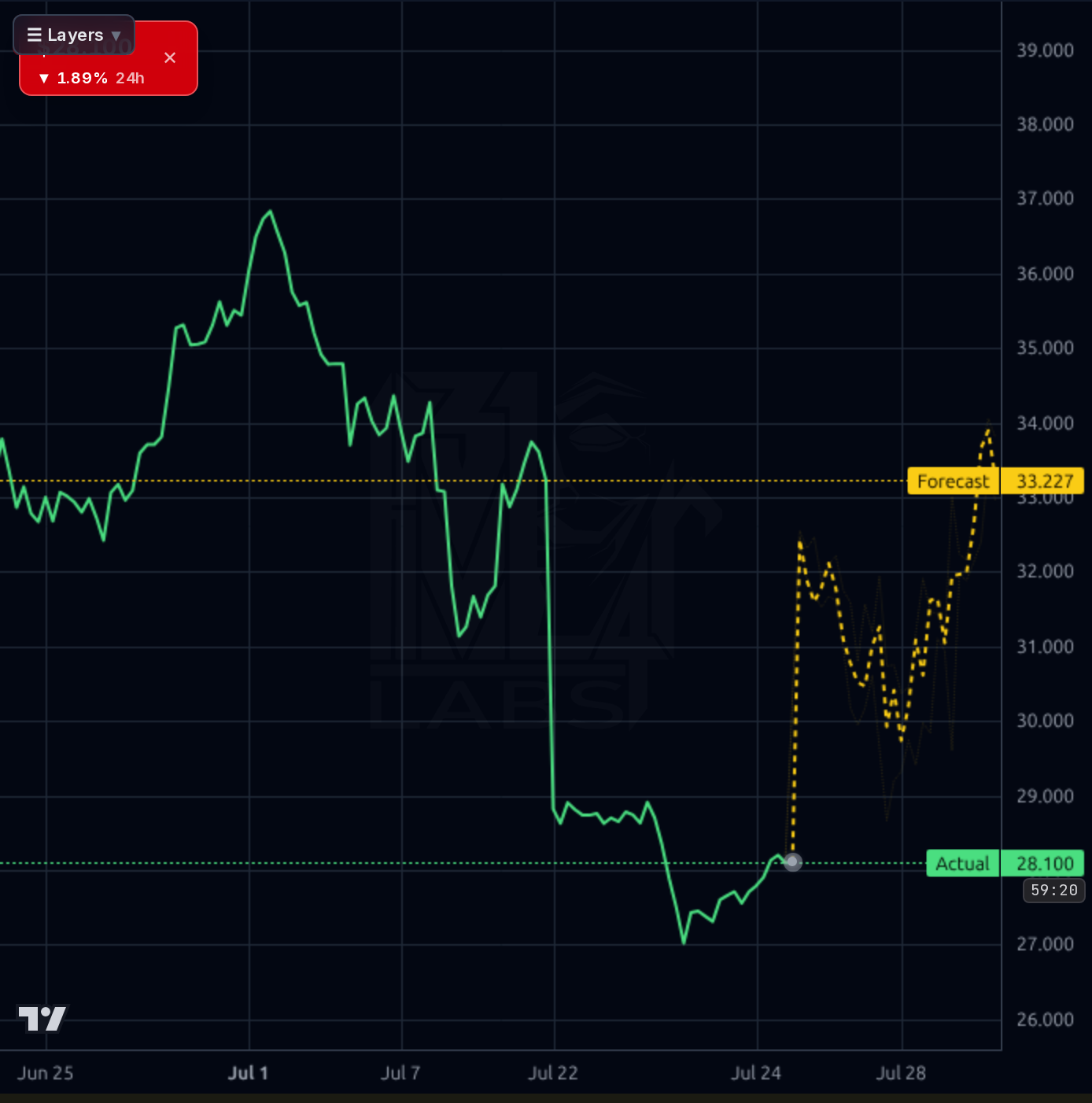
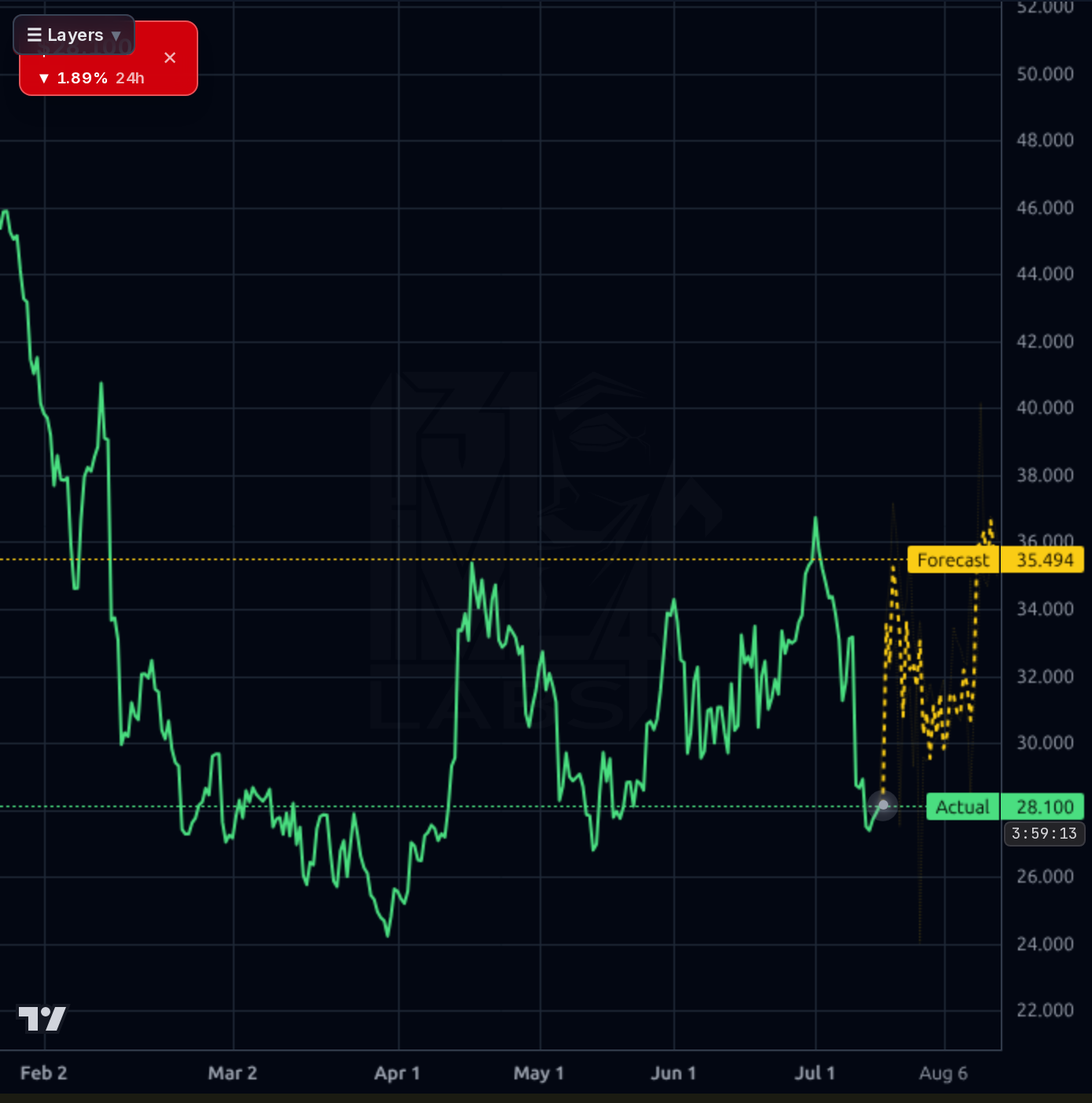
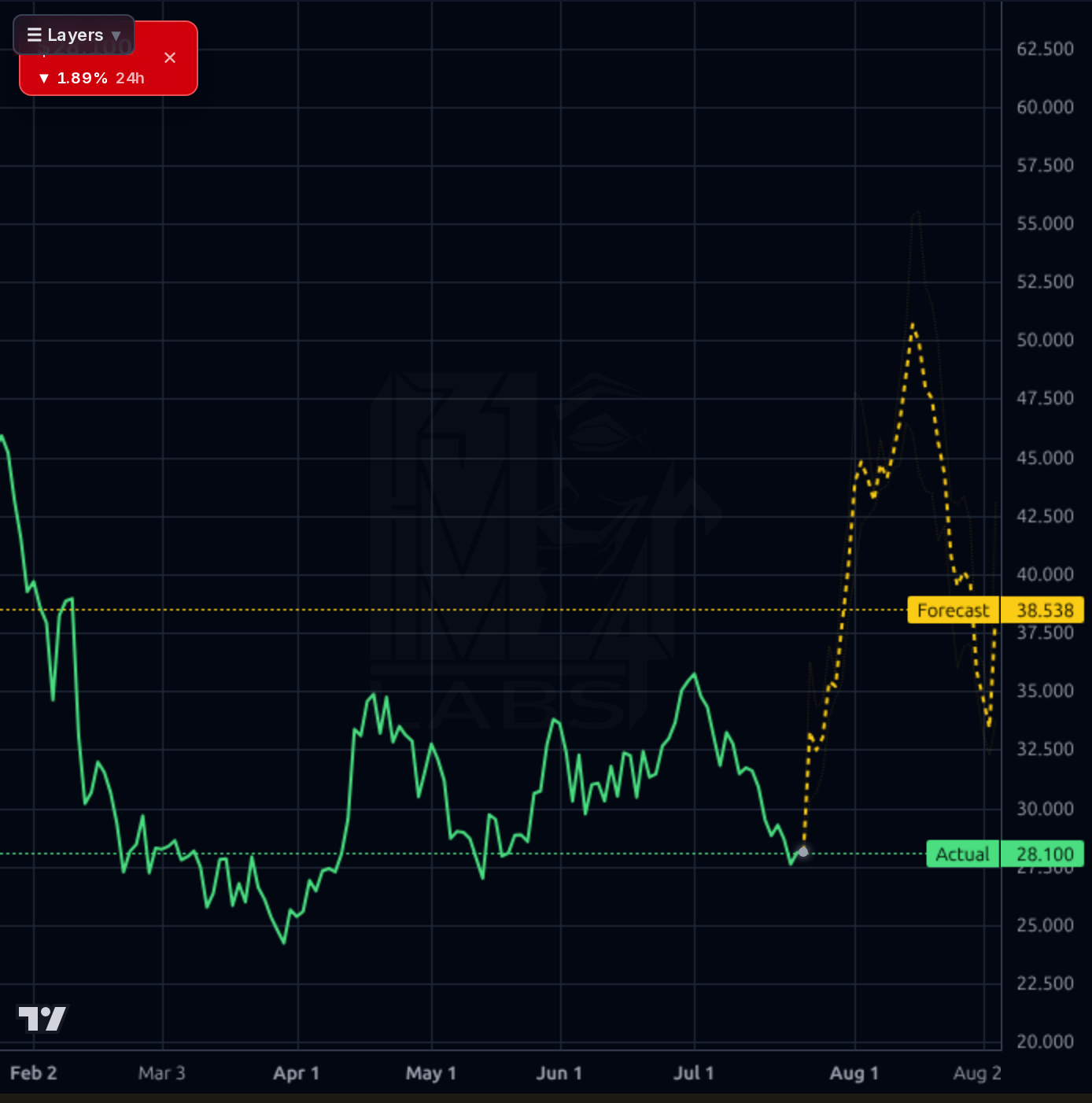
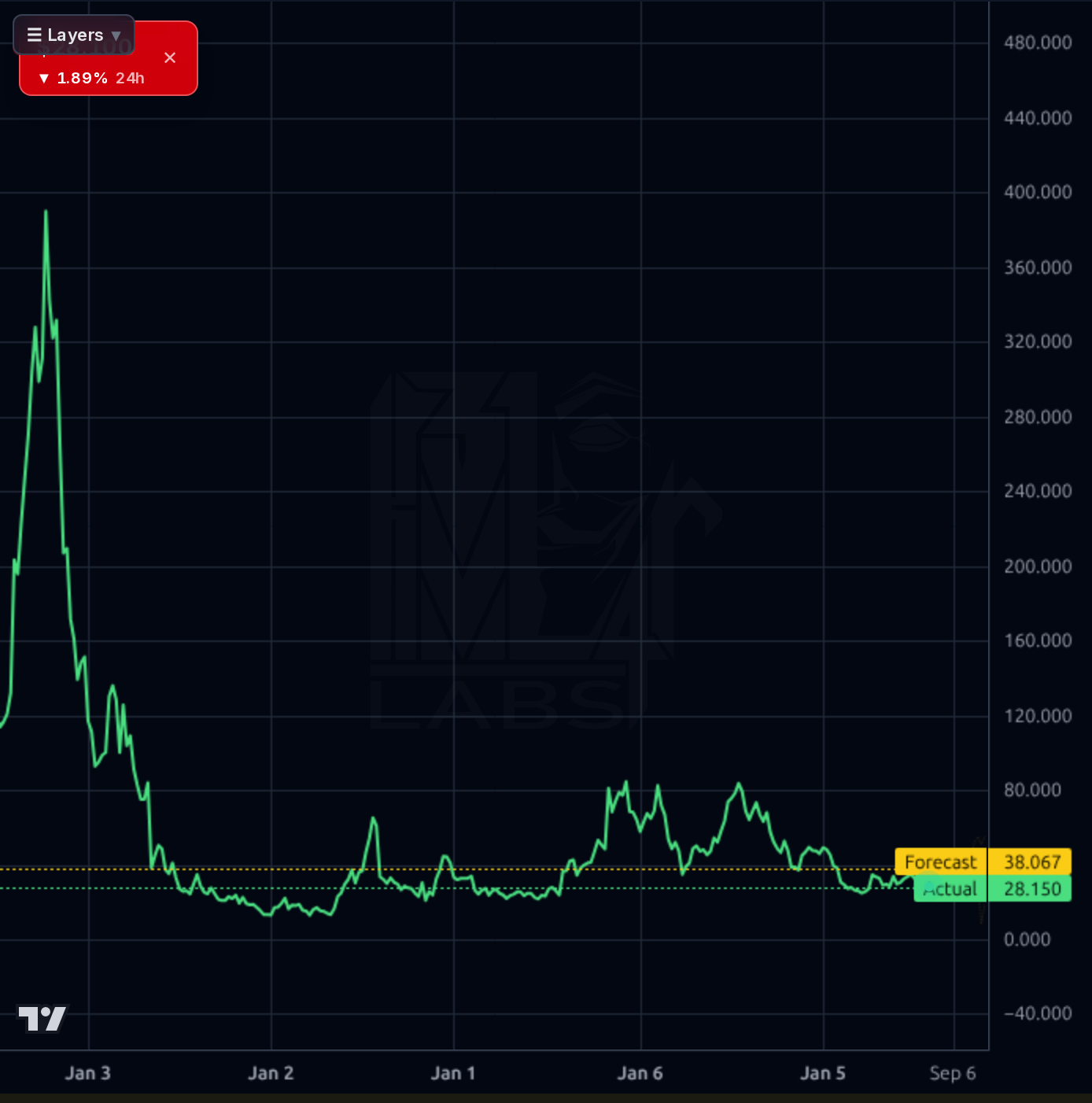
Structurally broken. Price at $27.59 is -14% below SMA20, -12% below SMA50, -25% below SMA200 — a textbook downtrend across every meaningful timeframe. RSI 33.9 is approaching oversold but not yet capitulating. The 1h chart shows a violent leg down from $37 (Jul 1) through $31 support to a $27 low, with a small bounce back to $28. The 4h chart confirms the $28-29 zone as prior support that is now being retested from below after the breakdown. The 1d chart shows the stock has round-tripped the entire Apr-Jun rally and now sits just 15% off the 52w low of $23.97 — the next major technical floor. The internal Kronos forecast band ($30-35 across timeframes) implies a sharp mean-reversion bounce, but the accuracy table is damning: 1d directional accuracy 10% vs 92% naive baseline, 1wk 33% vs 100% naive — the model is systematically wrong on this name in this regime, so the yellow forecast should be heavily discounted. Realistic near-term ceiling is $31-32 (broken support flip); realistic floor is $23.97 on a bad print.
The material news is the OCC's conditional approval for Upstart Bank, N.A. announced July 23. This is a genuine structural positive — a bank charter would lower cost of funds and reduce dependency on warehouse/ABS take-out, addressing the single largest risk in the thesis. However, 'conditional' means the milestones are years, not quarters, and the market's reaction was muted (stock still -3.7% on the day, closing at $27.59). Secondary coverage is noise: Zacks flagging elevated retail attention, a Sezzle vs. Upstart comparison rating Sezzle better, and a Seeking Alpha 'undervalued' piece. TV chatter is minor. Social sentiment is contrarian bearish — Stocktwits messages are almost entirely capitulation posts ('Piece of shit,' 'I hate you UPST,' 'end our suffering') even though the platform tags them 'bullish,' suggesting the retail crowd is exhausted, not enthusiastic.
- OCC conditional approval (Jul 23) for Upstart Bank, N.A. — multi-year path but structurally lowers cost of funds if consummated
- Neuberger Berman $600M forward-flow renewal restoring institutional take-out capacity for personal loans
- Wafra $200M auto forward-flow agreement extending the funding base into the auto vertical
- ABS 2026-3 issuance pipeline (Aug 20 pricing watch) validating structured credit demand
- Cashline revolving credit and auto secured personal loan products expanding TAM beyond core personal installment
- Sell-side EPS estimates for next year revised +7 to +21pp bullish over past 45 days, indicating improving analyst confidence in the recovery arc
- -$133M Q1'26 operating cash flow and -$140M FCF reversing Q4'25's positive print — cash burn signals fragility, not durability
- 71x trailing P/E with $0.41 TTM EPS leaves zero cushion for an earnings miss on Aug 4
- D/E of 2.70x means any tightening in ABS/warehouse markets is an immediate solvency-adjacent concern
- Beta 2.29 amplifies any broader market drawdown, especially with breadth deteriorating below 50%
- 31.5% short float creates squeeze risk on any positive surprise but also confirms institutional bearish positioning
- Technical breakdown below $31 support with next floor at $23.97 (52w low); a bad print likely breaches this
- Internal forecast model has 10% vs 92% naive baseline accuracy on this name — its bullish 1d/1wk tilt is unreliable
- Q1'26 net loss of $6.6M after three profitable quarters suggests profitability was cyclical/timing-driven, not structural
Get AI analysis on any stock
This is one of hundreds of Kronos AI reports — scored fundamentals & technicals, bull/base/bear price targets, a multi-horizon plan, and continuously-updated forecasts across the market. Create a free account to explore them all.
Create your free account →Already a member? Sign in · Join our Discord